Website Scan & SEO: Turn Sitewide WordPress SEO Data Into Clear Action
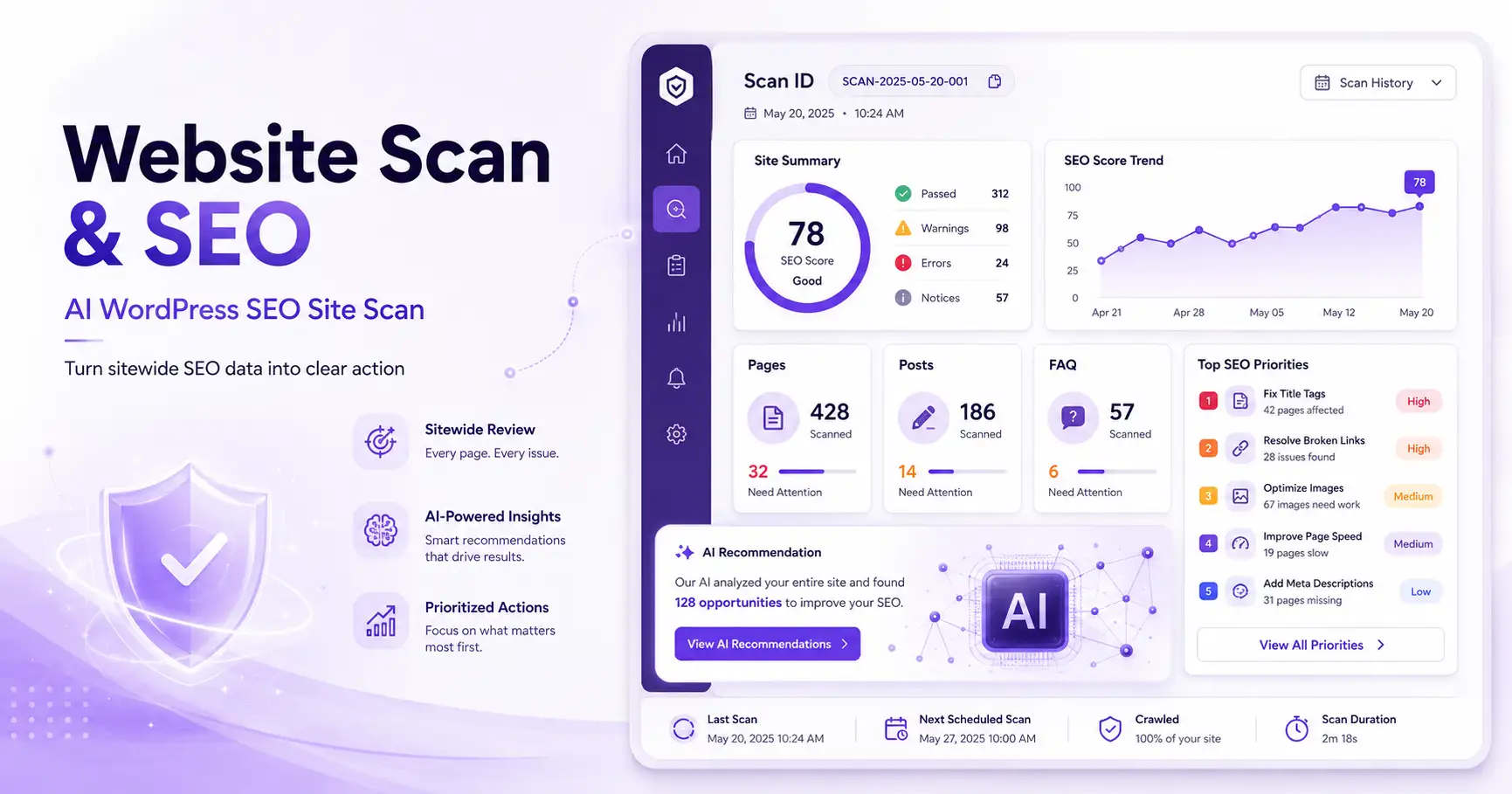
An AI WordPress SEO site scan should do more than count missing meta descriptions or score one page at a time. A useful WordPress SEO audit reviews pages, posts, FAQ content, internal links, sitemap and schema context, search settings, and AI-search readiness as one connected environment. Aegisify SEO’s Website Scan & SEO feature organizes those signals and gives WordPress teams a practical order of operations.
The harder problem is not finding SEO data. It is deciding what the data means. Weak page intent, thin topic coverage, unclear FAQs, poor internal links, and configuration gaps can combine to make a site harder for people and search systems to understand.
What Is Aegisify Website Scan & SEO?
Website Scan & SEO is a staged background review inside Aegisify SEO. An administrator starts a scan, the work continues without requiring the admin page to remain open, and the run is stored under a dated Scan ID. The report reviews published pages, posts, FAQ-style content, active plugin context, and the wider Aegisify SEO configuration.
That context can include Meta & Schema, AI SEO, Sitemaps, Issues & Fixes, Linking Assistant, Evidence, Custom Injections, and the SEO Ops Center. The objective is to identify the pages, gaps, and settings that deserve review first—not to treat every warning as urgent.
Why Sitewide Context Matters
Search performance is usually limited by several connected conditions rather than one dramatic mistake. A page can have a title and still communicate weak intent. A post can be accurate and still lack supporting detail. A sitemap can exist while valuable pages remain poorly linked. A FAQ can be visible to readers while failing to answer the questions people actually ask. Sitewide review helps expose those relationships.
What the AI SEO Scan Reviews
The scan is designed to organize the parts of WordPress SEO that are often reviewed separately.
01Pages
Reviews important pages for clear purpose, topical focus, useful summaries, and improvement opportunities.
02Blog Posts
Identifies posts that may need deeper coverage, clearer structure, supporting context, or fresher information.
03FAQ Content
Looks for thin answers and opportunities to address genuine buyer or search questions directly.
04SEO Configuration
Connects content findings with relevant Aegisify SEO settings and technical context.
05Content Opportunities
Suggests possible topics, keyword directions, and angles aligned with the site.
06Priority Order
Ranks recommendations so teams address high-impact conditions before low-value cleanup.
How the Website Scan & SEO Workflow Works
The workflow is designed for repeatable SEO operations rather than a one-time score.
1Start
An administrator launches a full AI SEO scan from the Website Scan & SEO tab.
2Inventory
Aegisify reviews published content and the relevant WordPress and SEO context.
3Analyze
Rule-based checks and AI-assisted analysis identify patterns, gaps, and possible priorities.
4Recommend
The report explains what needs attention, why it matters, and where the user should review it.
5Compare
The dated Scan ID gives teams a record they can revisit after content and configuration changes.
| Finding | Why It Matters | Aegisify Review Path |
|---|---|---|
| Unclear page intent | Searchers and answer engines may struggle to identify the page’s purpose or value. | High Priority Strengthen the topic, title, headings, summary, and supporting details through content and Meta & Schema. |
| Thin supporting content | A page may mention a subject without answering the questions needed for useful coverage. | Important Identify missing subtopics, examples, definitions, and internal-link opportunities. |
| Weak FAQ coverage | Visitors may leave without answers, while machines receive less direct question-and-answer context. | Important Expand visible FAQs around genuine questions. Use schema only when it matches the page. |
| Disconnected internal links | Important pages may become harder to discover and receive less contextual support. | Opportunity Review Linking Assistant and the connected Aegisify link workflow. |
| Sitemap or discovery gap | Search systems need consistent crawl paths and current URL signals. | High Priority Review Sitemaps, crawler access, canonicals, and the connected sitemap workflow. |
AI
Context Beyond Checklists
How Artificial Intelligence Improves the WordPress SEO Audit
Traditional checks reliably detect known conditions such as a missing description, short heading, broken link, or blocked resource. Their limitation is context. A rule may not explain whether the issue affects a primary service page, an old archive, or a high-value post.
Aegisify SEO’s AI-assisted layer makes the report easier to understand. It can explain why a page needs stronger focus, a post needs supporting detail, a FAQ needs clearer answers, or a content theme deserves expansion. Recommendations remain a starting point; accuracy, usefulness, brand voice, and business relevance still require human judgment.
SEO
Search and AI-Search Readiness
Build for Crawling, Indexing, Understanding, and Useful Answers
Durable AI SEO begins with durable search SEO. Important pages should be crawlable, indexable when appropriate, internally linked, clearly titled, well structured, and useful. Google’s guidance for generative AI search emphasizes foundational SEO, people-first content, technical clarity, and accurate information. Bing likewise emphasizes crawlable links, current sitemaps, and reliable discovery.
The scan can surface opportunities for direct definitions, descriptive headings, concise summaries, useful FAQs, consistent product naming, and evidence-backed claims. These practices improve clarity, but no plugin can guarantee that any search or AI system will index, cite, or rank a page.
How Aegisify Products Support the Improvement Path
Aegisify SEO provides the central review and prioritization workflow. Meta & Schema supports titles, descriptions, and structured context. AI SEO supports explainable recommendations. Issues & Fixes and the SEO Ops Center help organize technical work. Linking Assistant supports internal discovery paths. Evidence and saved Scan IDs help teams preserve context over time. Where installed and licensed, connected Aegisify sitemap and link products can support discovery and internal-link operations. The product value is not another disconnected score; it is a clearer path from finding to review, action, and follow-up.
How This Approach Differs From Other WordPress SEO Tools
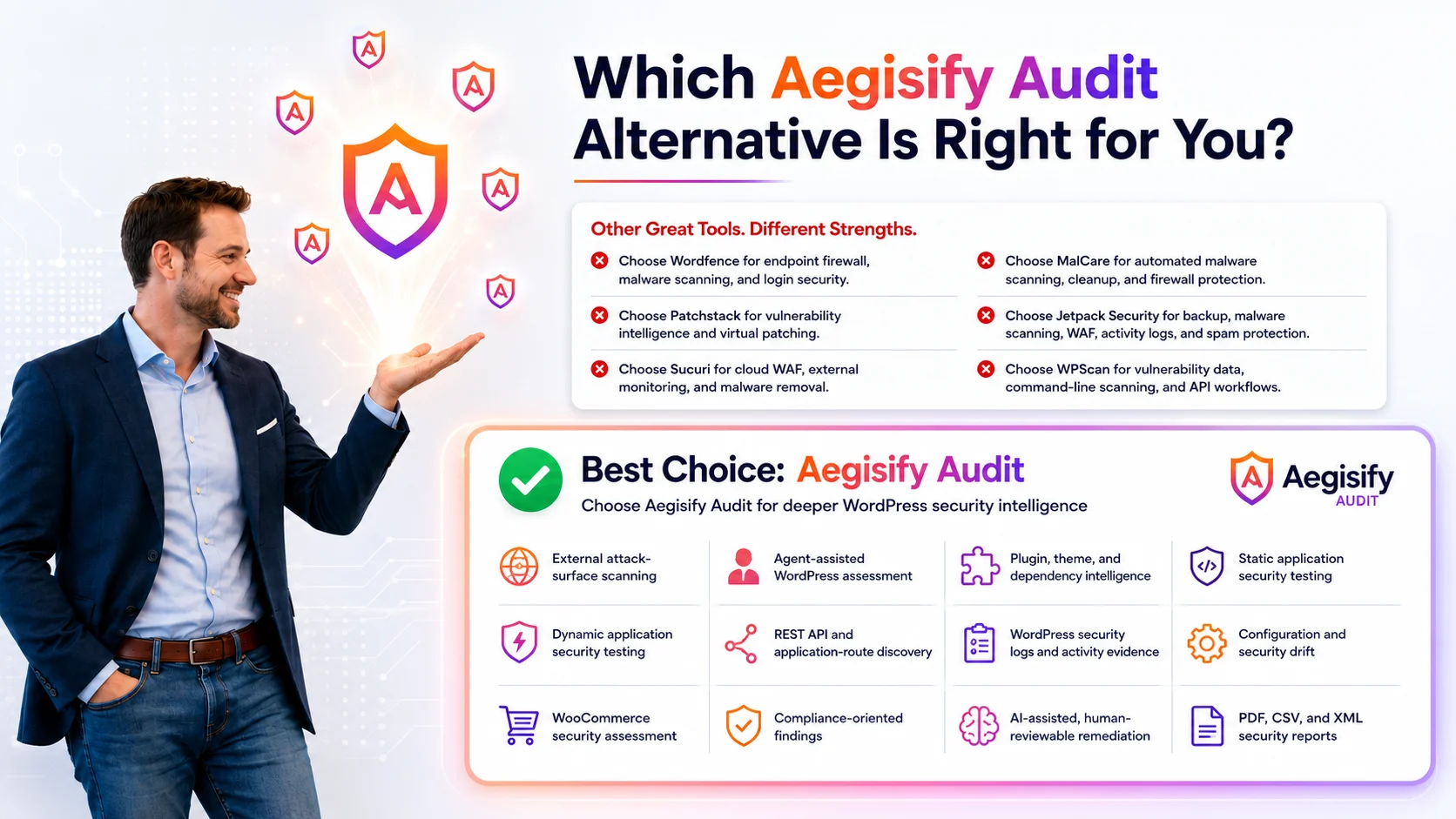
Yoast publicly emphasizes real-time SEO and readability analysis. Rank Math promotes built-in optimization suggestions and Content AI for research, writing, optimization, and related workflows. AIOSEO offers site audit and checklist experiences that identify issues and recommended improvements. Those are legitimate approaches.
Aegisify Website Scan & SEO is designed around a stored, scan-based operating model. It brings content review, FAQ opportunities, plugin and configuration context, Aegisify SEO feature recommendations, and ranked priorities together under a dated Scan ID. This is a focused product direction, not a claim that competing tools cannot support adjacent tasks.
Who Benefits From a Sitewide AI SEO Scan?
Site owners gain a clearer answer to what should improve next. Marketing teams receive a prioritized backlog. Agencies gain a repeatable client-review model. WooCommerce operators can focus on pages tied to products and conversion. Historical Scan IDs help teams revisit findings and evaluate progress.
The value is better decision-making: identify material gaps, understand why they matter, direct work to the right SEO area, and scan again after improvements—not promise rankings.
Website Scan & SEO FAQ
Does the scan guarantee higher Google rankings?
No. It identifies and prioritizes opportunities. Search engines control crawling, indexing, presentation, and ranking.
Does it analyze only one page at a time?
No. It reviews pages, posts, FAQ content, plugin context, and relevant Aegisify SEO configuration.
Why are Scan IDs important?
They preserve a dated record so teams can revisit recommendations and compare later scans.
Can AI replace an SEO professional?
No. People must validate accuracy, priority, brand fit, technical safety, and implementation.
What should be fixed first?
Start with crawl and index blockers, canonical or sitemap problems, unclear high-value pages, and material content gaps.
Search and Product Documentation
Editorial references include Google’s generative AI optimization guide, Google’s people-first content guidance, Google Search Essentials, Google’s generative AI content guidance, Bing Webmaster Guidelines, OpenAI publisher guidance, Yoast readability analysis, Rank Math Content AI documentation, and AIOSEO SEO Audit Checklist.