WordPress DAST vs SAST: Why Runtime Testing and Static Code Analysis Work Better Together
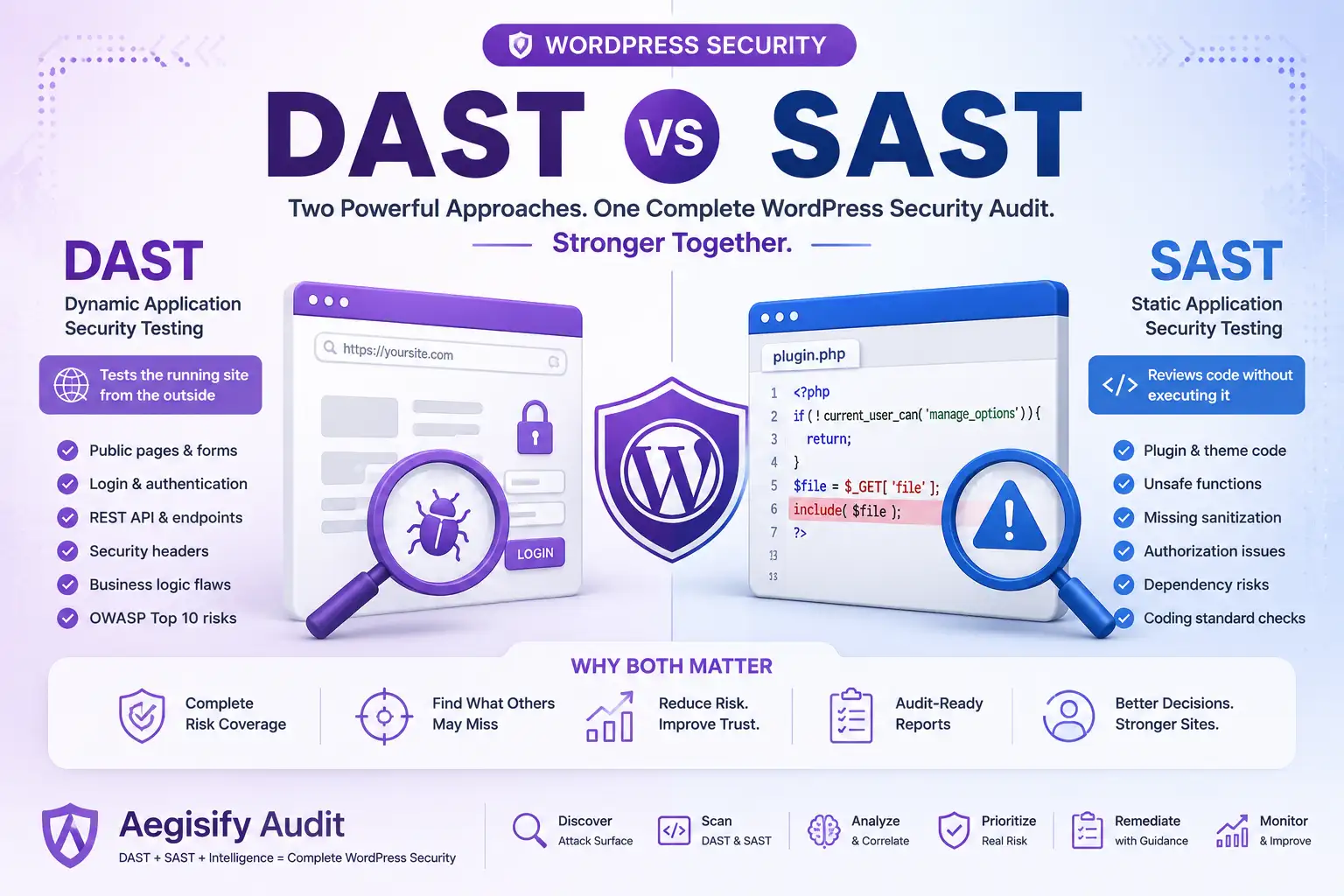
WordPress DAST vs SAST is not a choice between competing security methods. A WordPress DAST scanner tests the running website from the outside, while WordPress static code analysis reviews plugins, themes, custom PHP, and related files without executing the application. One reveals exposed behavior. The other reveals code-level conditions that may create risk.
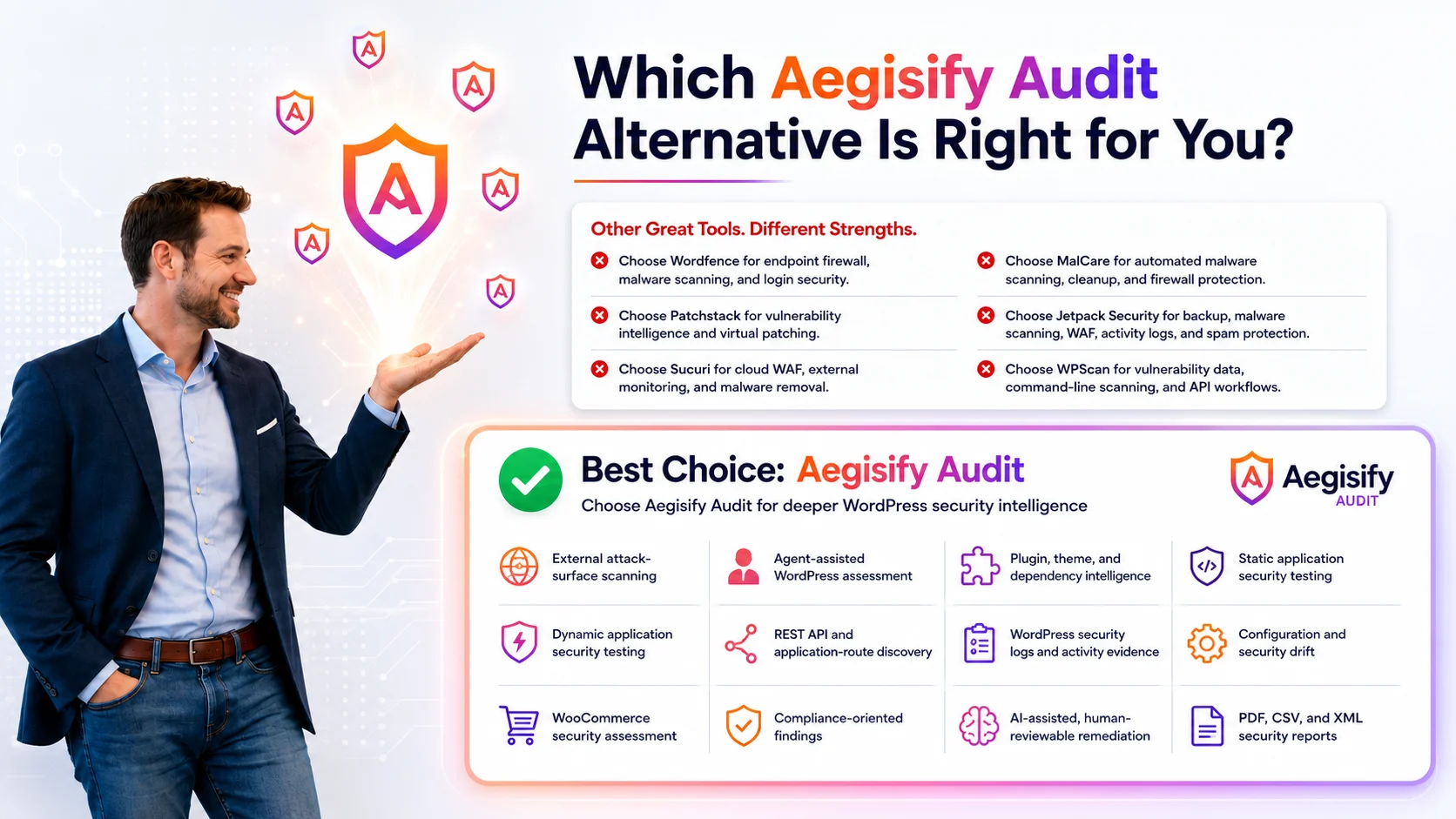
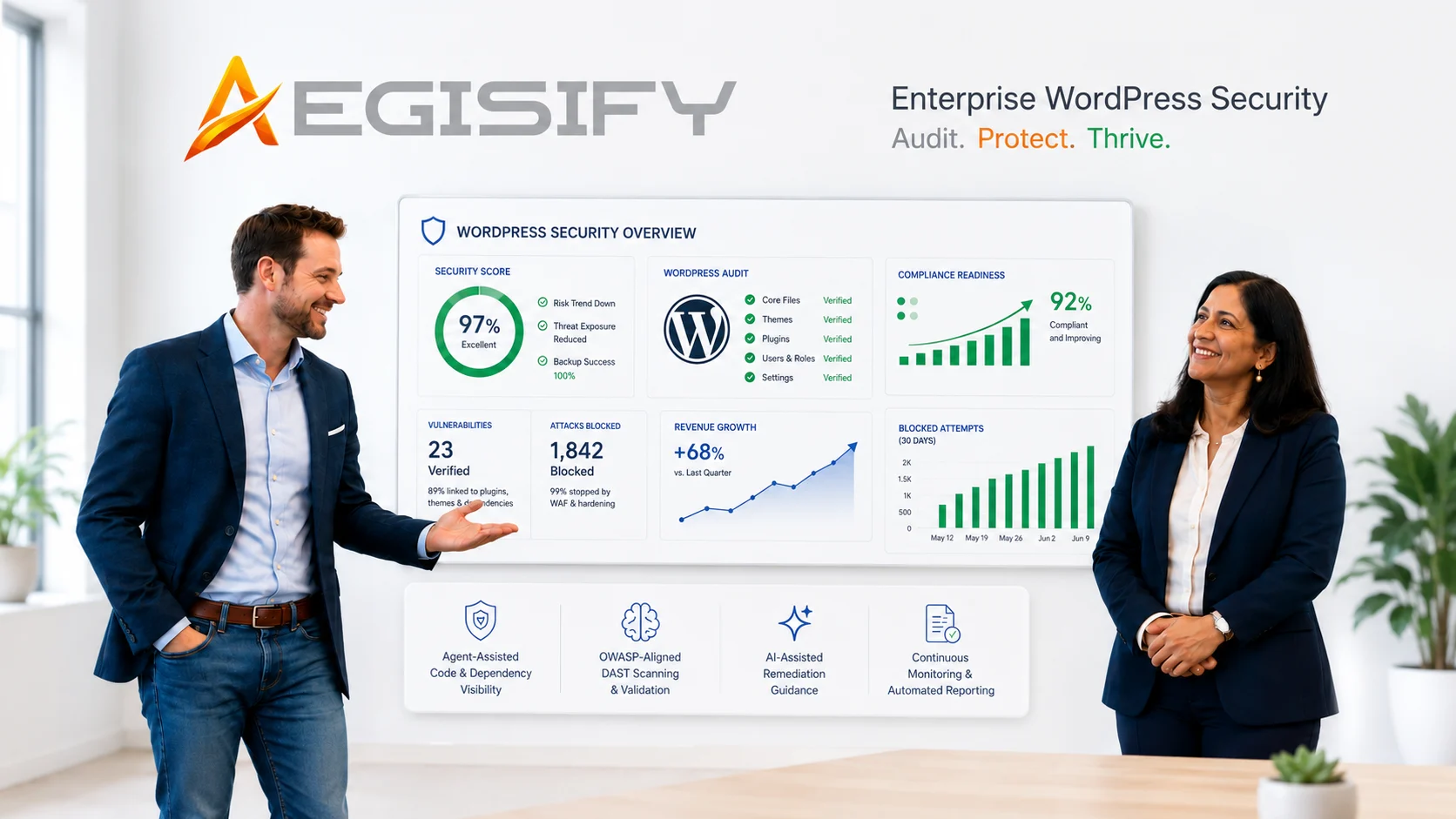
For agencies, WooCommerce operators, developers, and mission-critical site owners, both perspectives matter. Aegisify Audit brings DAST-style testing together with Agent-side static analysis, vulnerability intelligence, logs, attack-surface evidence, and reviewable remediation guidance.
Dynamic application security testing evaluates an application while it is running. A scanner interacts with public pages, forms, parameters, authentication surfaces, APIs, headers, and application responses without needing access to source code. It can identify exposure that becomes visible only after WordPress, plugins, themes, the web server, and connected services are operating together.
Static application security testing analyzes source code or compiled code without running the application. In WordPress, that can include custom plugins, themes, PHP classes, REST callbacks, database logic, file operations, and other implementation details. Static analysis can identify risky patterns earlier, but findings still require context and validation.
Why WordPress Needs More Than One Testing Method
WordPress risk does not live in one layer. Runtime configuration can expose a route even when code appears reasonable. Code can contain a missing capability check even when a scanner misses the affected action. Plugins, themes, hosting, caching, CDNs, authentication, WooCommerce extensions, and integrations all shape the final attack surface.
What a WordPress DAST Scanner Reviews
A DAST-style assessment observes the website as a remote client. OWASP describes DAST as testing an application while it runs through black-box requests and response analysis. For WordPress, many issues depend on configuration, reachability, user state, or how components behave together.
Public and Browser-Facing Surfaces
- Public pages, forms, and parameters
- Login and registration behavior
- Security headers and cookies
- Exposed files, logs, and install artifacts
- JavaScript and source-map signals
- Redirect and response behavior
Application and Commerce Surfaces
- WordPress REST API routes
- AJAX actions and public endpoints
- GraphQL or OpenAPI surfaces where present
- WooCommerce cart and checkout flows
- Account, order, payment, and webhook paths
- Authenticated workflows when authorized
Aegisify Audit uses profiles such as Quick DAST, Enterprise DAST: App & Commerce, Deep Auth DAST, and API DAST for different levels of public, authenticated, application, API, and ecommerce review. Testing should be authorized, scoped, rate-aware, and planned to avoid production disruption.
What WordPress Static Code Analysis Reviews
Static analysis examines implementation details an external scanner may never reach. WordPress guidance emphasizes validating and sanitizing input, escaping output, checking capabilities, and using nonces correctly. Static review can find missing or inconsistent controls in custom code.
WordPress Security Patterns
- Missing sanitization or validation
- Missing output escaping
- Weak nonce verification
- Missing capability checks
- Unsafe SQL construction
- Insecure file and upload handling
Custom-Code and Quality Risks
- Dangerous function usage
- Hardcoded secrets or credentials
- Untrusted data flows
- Risky REST permission callbacks
- Custom plugin and theme defects
- WordPress coding-standard problems
Static analysis is especially valuable for custom plugins, themes, WooCommerce customizations, membership sites, portals, dashboards, and REST endpoints. It can produce false positives when a tool cannot understand every data flow or compensating control, so findings require review.
SAST and Dependency Scanning Are Related but Different
SAST focuses on code-level flaws. Software composition analysis and vulnerability scanning focus on third-party packages, versions, and known component risk. A strong WordPress audit may use all three: static analysis for coding conditions, component intelligence for vulnerable dependencies, and DAST for real runtime exposure.
| Security Testing Area | DAST | SAST |
|---|---|---|
| Tests a running website | Strong Observes live application behavior and responses. | No Reviews code without executing the application. |
| Reads source code | No Usually operates without internal code visibility. | Strong Analyzes source or compiled code and implementation patterns. |
| Finds public exposure | Strong Useful for reachable routes, forms, headers, files, and runtime configuration. | Contextual May identify code that creates exposure but cannot confirm every deployed condition. |
| Finds coding mistakes | Limited Can reveal symptoms but not always the exact source line or logic flaw. | Strong Useful for unsafe functions, data handling, permissions, and custom logic. |
| API and REST review | Runtime View Tests reachability, methods, authentication, inputs, and responses. | Code View Reviews route registration, permission callbacks, validation, and handlers. |
| WordPress example | REST route permits an unintended public action. | A plugin registers the route with a missing or weak permission callback. |
| Primary limitation | May miss unreachable code, hidden logic, or paths not exercised by the scan. | May produce false positives and cannot fully reproduce deployment behavior. |
How a Combined WordPress Security Audit Works
The strongest workflow uses each method for the evidence it can provide, then correlates results before remediation.
Why Agencies and WooCommerce Operators Should Care
Agencies often inherit sites with dozens of plugins, abandoned custom code, old themes, unknown administrators, and years of WooCommerce extensions. DAST alone can miss hidden code risk. SAST alone can miss how production configuration, authentication, caching, payments, and third-party services expose that code.
How Aegisify Audit Brings the Evidence Together
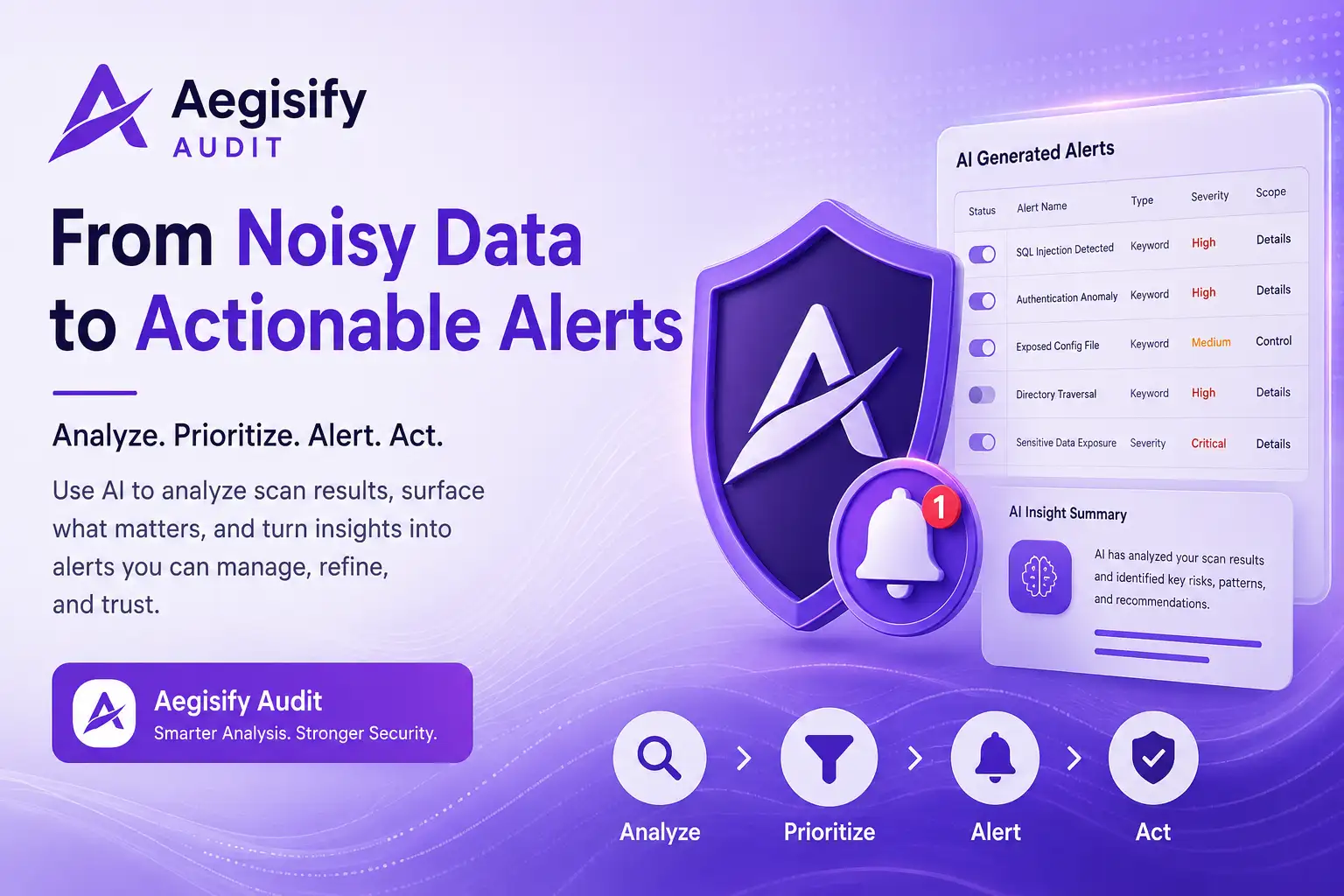
Aegisify Audit combines WordPress-focused DAST-style profiles with Agent-side static analysis. The workflow can also include vulnerability scanning, attack-surface discovery, REST and GraphQL review, WooCommerce checks, logs, activity signals, compliance indicators, AI-assisted remediation notes, and reporting.
The value is not producing more findings. It is connecting visible conditions with local code, components, configuration, and activity evidence. Teams can prioritize unauthenticated exposure, checkout risk, exploitable custom logic, vulnerable dependencies, and high-impact misconfiguration ahead of noise.
Aegisify Audit supports human decision-making; it does not replace penetration testing, secure development, code review, incident response, or qualified security judgment. Automated findings should be validated before production changes are approved.
WordPress DAST vs SAST FAQ
Is DAST better than SAST?
No. DAST reviews runtime behavior and public exposure. SAST reviews code-level conditions. The right method depends on the question, and the strongest assessment uses both where appropriate.
Does every WordPress site need static code analysis?
Sites with custom plugins, custom themes, WooCommerce customizations, membership workflows, private portals, or custom APIs benefit most. Standard sites can still gain value when plugin or theme code requires deeper review.
Can DAST safely test a production WooCommerce site?
Testing must be authorized and carefully scoped. Aggressive payloads, account actions, cart operations, or payment-related requests can affect availability or data. Use rate controls, safe profiles, staging where practical, and explicit exclusions for sensitive transactions.
Is vulnerability scanning the same as SAST?
No. Vulnerability scanning often correlates installed component versions with known issues. SAST analyzes code for implementation flaws. Software composition analysis focuses on third-party dependency risk. These methods complement one another.
Can Aegisify Audit replace a human security review?
No. It helps collect, correlate, prioritize, and report evidence so site owners, agencies, developers, and security reviewers can make better decisions.
Application Security and WordPress References
Editorial references include OWASP DAST guidance, OWASP source-code analysis guidance, OWASP Top 10:2025, OWASP Web Security Testing Guide, WordPress Plugin Security guidance, WordPress sanitizing guidance, WordPress escaping guidance, and WordPress capability-check guidance.