WordPress Spam Protection for Forms, Registrations, WooCommerce and REST
WordPress spam protection, form spam filtering, fake-registration defense, WooCommerce anti-spam, comment moderation, REST API abuse controls and privacy-first bot detection should operate as one coordinated system. Spam does not stay inside the comment box. It moves through contact forms, account creation, newsletter signups, product reviews, checkout fields, search requests, custom forms and API endpoints.
Aegisify Spam Guard is designed for WordPress sites that need broad coverage and understandable decisions. It combines local scoring, behavior signals, velocity checks, content analysis, identity patterns, request fingerprints, optional local learning, privacy controls, cleanup tools and early firewall filtering inside WordPress.
Spam Is an Operational Cost, Not Just a Moderation Problem
Every unwanted submission creates work. Fake users inflate account tables. Link-filled comments consume moderation time. Contact-form spam reaches sales inboxes. Newsletter bots weaken list quality. Checkout abuse can create abandoned orders or inaccurate ecommerce reporting.
High-volume automation also consumes application resources. WordPress must load plugins, validate fields, query the database, create records or send email before a traditional moderation workflow can clean up the result. As traffic and form coverage grow, filtering after submission becomes less efficient.
A useful anti-spam strategy therefore needs three outcomes: reduce low-quality data, protect the visitor experience and give administrators enough evidence to tune protection safely.
Comments and Reviews
Evaluate content, links, timing, identity and repetition before SEO spam or review abuse reaches public moderation queues.
Forms and Signups
Protect supported contact, subscription, registration and custom-form workflows with one scoring model and adapter strategy.
WooCommerce
Review checkout, account, order-note and product-review activity without treating every high-volume customer event as abuse.
REST and Search
Identify automated request patterns that target WordPress search or supported API submission paths outside traditional forms.
Allow, Challenge, Hold or Block Based on Combined Evidence
Aegisify Spam Guard evaluates supported submissions with signals from behavior, content, identity, location, fingerprints and submission velocity. Those signals contribute to a score and policy decision rather than relying on one field or keyword.
Clear response bands create a safer rollout. Low-risk activity can be allowed. Traffic that needs more confidence can receive a challenge. Borderline submissions can be held for review. Strongly suspicious activity can be blocked. This gives busy sites a way to begin conservatively and tighten thresholds after reviewing real outcomes.
No score is perfect. Legitimate users can submit quickly, share several links or use privacy tools. Attackers can also imitate normal timing. Administrators should test forms, review held events and adjust weights before enabling aggressive enforcement across revenue-critical workflows.
How the Spam Decision Workflow Operates
Collect the supported behavior, content and identity signals.
Apply configured weights and local policy context.
Allow, challenge, hold or block the submission.
Record the reasons and signal breakdown in the Spam Log.
Review outcomes, train locally and adjust controls.
Behavior and Timing
Very fast submissions, missing browser behavior or unusual interaction patterns can increase suspicion. Timing should be combined with other signals because real visitors do not all complete forms at the same speed.
Velocity Controls
Repeated activity from a privacy-safe fingerprint during a defined window can reveal spam bursts. Thresholds should match expected campaign, editorial and ecommerce traffic.
Honeypots and JS Proof
Invisible fields can catch simple automation, while optional JavaScript proof can reduce headless POST abuse without forcing every visitor through a visual CAPTCHA.
Content and Identity
Link volume, suspicious destinations, repeated templates, disposable email patterns and optional domain checks can strengthen a decision when several indicators agree.
The Spam Log Shows Why a Submission Was Flagged
Anti-spam tools create operational risk when administrators cannot explain a block. Aegisify Spam Guard records human-readable reasons such as a triggered honeypot, burst activity, disposable email pattern or unusually fast submission.
The Spam Log becomes both an audit trail and a tuning workspace. Administrators can review the score breakdown, inspect context and apply supported actions such as allow, block, train as spam or train as not spam. Bulk workflows help manage spikes without opening every event individually.
Explainability does not reveal every detection detail to the public visitor. The purpose is to give authorized administrators enough evidence to understand the decision, reduce false positives and document why a policy changed.
Replace Spam Guesswork With Reviewable WordPress Decisions
See the score, inspect the reasons, tune the policy and keep legitimate submissions moving.
Early Filtering Can Reduce WordPress Work
Aegisify documents an optional local Spam Firewall designed to stop supported abusive requests before the full WordPress application completes normal processing. A minimal response can reduce the information and resources provided to obvious automation.
This is not a network firewall or universal DDoS service. Requests still reach the hosting environment, and compatibility must be tested with caches, proxies, forms, APIs, ecommerce callbacks and legitimate integrations.
Local-First Privacy Gives Administrators Choices
Aegisify supports local scoring, optional local learning, a no-external-calls mode, configurable IP handling, salted hashing and retention controls. These options can reduce unnecessary disclosure and stored data when configured appropriately.
Local processing also means the site must supply the required resources. Teams should monitor database growth, scheduled cleanup and performance, and should document the data choices reflected in their privacy policy.
Akismet, CleanTalk and Aegisify Use Different Operating Models
The most useful comparison is not a claim that one product wins every category. It is a choice between different workflows, data paths and administrator priorities based on current public documentation.
| Product | Publicly Described Focus | Best Evaluation Question |
|---|---|---|
| Akismet | Cloud-backed filtering centered on comment, form and text spam, with integration into WordPress moderation. | Does the supported form coverage and external service model match the site’s workflow and privacy requirements? |
| CleanTalk | Cloud anti-spam for websites and ecommerce with CAPTCHA-free filtering and broad platform integrations. | Does the cloud service, integration coverage and account-based operating model fit the organization? |
| Aegisify Spam Guard | Local, explainable scoring across comments, forms, registrations, WooCommerce, REST and other supported inputs. | Does the team value local control, score transparency, tunable policies and optional no-external-calls operation? |
Plugin Check Supports Quality Review, but It Is Not a Certification
WordPress.org’s Plugin Check tool helps developers identify directory requirements and concerns involving accessibility, performance, security and coding practices. It is useful before a directory submission and for independent code review. WordPress.org also states that the tool is not a replacement for manual review and does not guarantee directory approval.
Public copy should therefore avoid saying that an unpublished plugin is “WordPress approved” or guaranteed to enter the directory. The accurate claim is that Plugin Check can support development quality and submission readiness.
Measure Spam Protection by Business Outcomes
Blocked-event totals can be useful, but the stronger metrics are moderation time, legitimate-submission success, database growth, form completion, newsletter quality, checkout reliability and email deliverability. A policy that blocks more traffic but loses qualified leads is not performing well.
Aegisify Spam Guard gives administrators the evidence to review those tradeoffs. Start with monitored or hold-oriented policies, label representative events, inspect false positives and then increase enforcement where the data supports it.
WordPress Spam Protection FAQ
Does Aegisify Spam Guard require a CAPTCHA?
It supports low-friction controls such as honeypots, behavior checks and optional JavaScript proof. Challenge behavior and integration support should be validated against the current production build.
Can local learning eliminate false positives?
No. Local training can improve site-specific decisions, but administrators still need representative labels, monitoring and periodic policy review.
Does no-external-calls mode make a site legally compliant?
No. It can support data-minimization goals, but compliance depends on the organization’s data flows, notices, retention, contracts, security and applicable law.
Can the Spam Firewall replace Aegisify WAF?
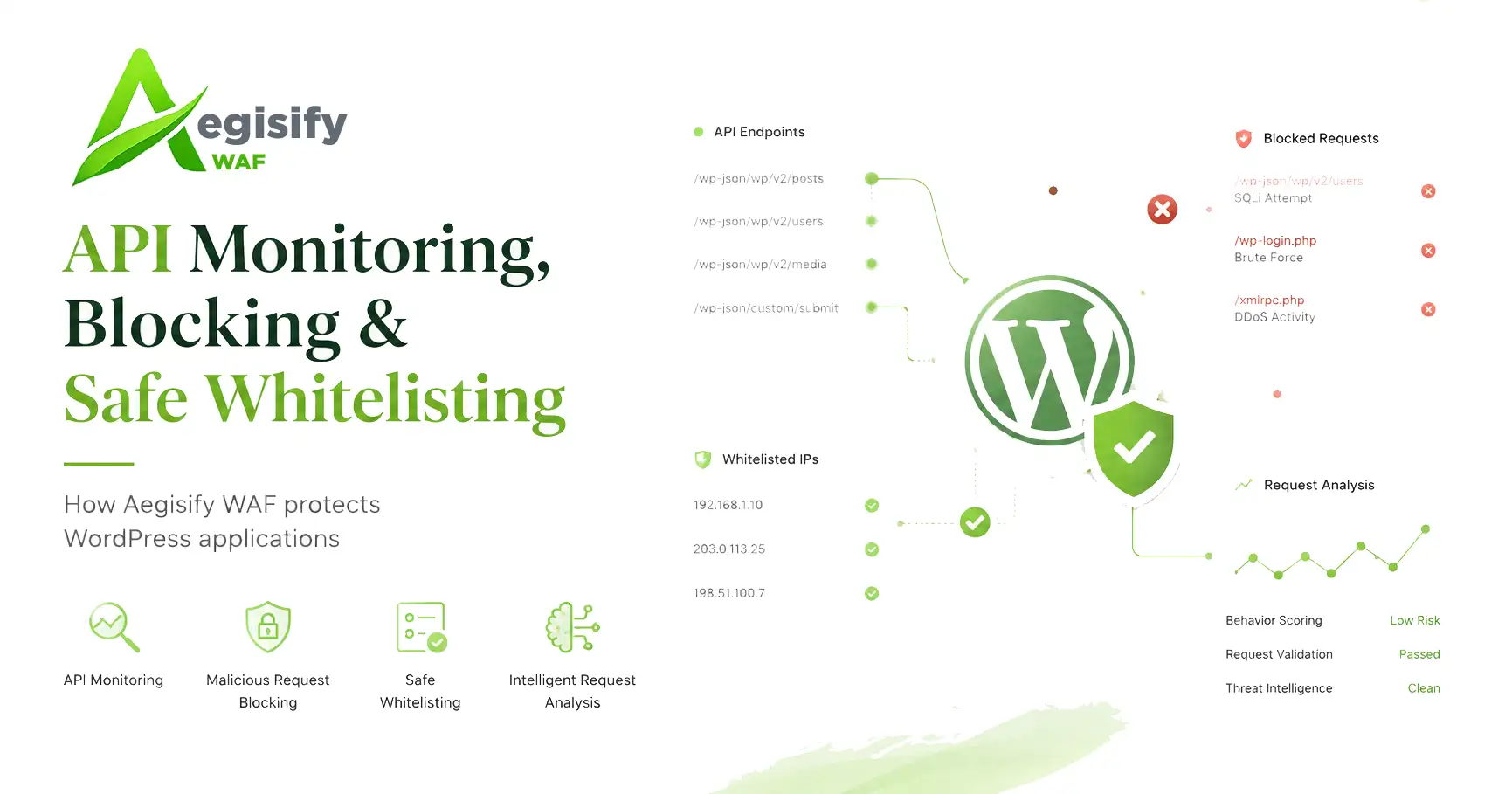
No. Spam Guard focuses on supported spam and submission abuse. Aegisify WAF addresses broader malicious request patterns, endpoint controls and application-layer traffic policy.
Should strict blocking be enabled immediately?
Begin with logging or hold-oriented settings, test critical forms and ecommerce paths, review outcomes and tighten policies gradually.
Product and WordPress References
Editorial references include Aegisify Spam Guard, the Aegisify Product Guides, Akismet for WordPress, CleanTalk Anti-Spam, and the official WordPress.org Plugin Check tool.