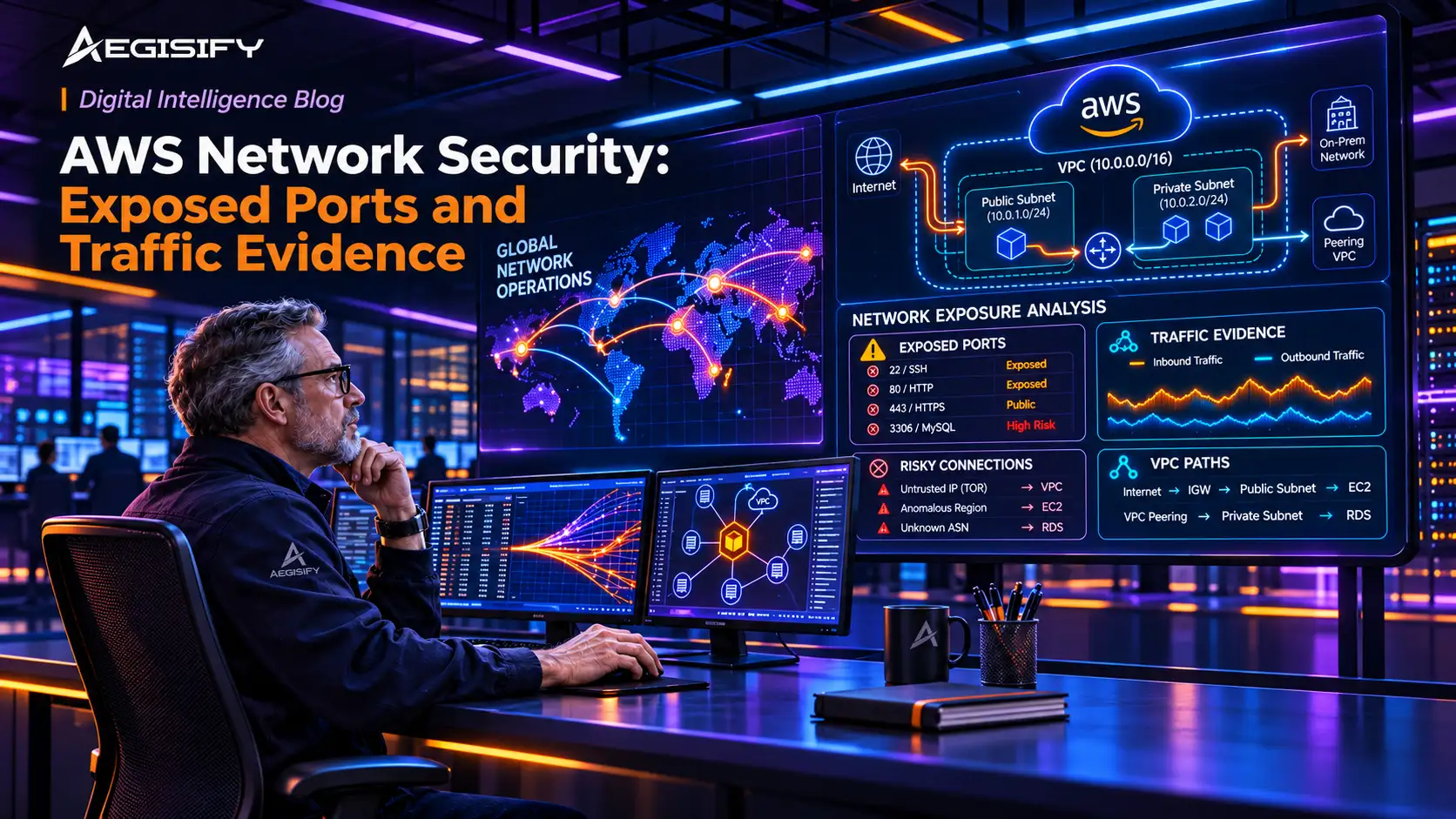
AWS Network Security: Exposed Ports and Traffic Evidence
An open port can create risk. But a security group rule alone cannot tell you whether an attacker can actually reach a workload—or whether traffic reached it.
Check the security group rule, its account and VPC context, then review routing and traffic evidence from enabled AWS sources. Digital Intelligence surfaces supported rule observations and log-source coverage to focus that investigation.
Check protocol, port, CIDR, group and associated asset.
Review the exact AWS account, VPC and authorized Region.
Identify actual destination configuration and data availability.
Recommend least-privilege ingress and verify a new observation.
Open-to-the-world does not automatically mean reachable
A rule allowing *******/0 or ::/0 on SSH or RDP deserves examination. Effective reachability also depends on routing, network interfaces, other network controls and the target service.
Where VPC Flow Logs or AWS WAF logging is configured, those sources may provide additional traffic or request evidence. A configured destination is not proof that a specific packet or request was captured.
Example: SSH open to IPv6
An engineer finds a security group allowing inbound TCP 22 from ::/0. The immediate step is to verify whether the associated workload has effective ingress and whether the rule is justified. If permitted flow records exist, inspect source and destination fields; otherwise report the evidence gap.
From exposed port to network-security decision
- Find the rule, not just a score
Inspect observed security group references and world-open sensitive-port indicators in the Security Intelligence workspace.
- Check traffic evidence
Determine whether configured VPC Flow Logs or WAF log destinations and required permissions support a targeted query. Do not turn missing logs into an “all clear.”
- Validate the remedy
Ask the AWS owner to remove unnecessary *******/0 or ::/0 access, narrow the approved source range, and confirm the rule and reachability after the change.
Questions security teams ask
Does an open SSH rule prove an attacker got in?
No. It shows a potentially dangerous permission, not successful connectivity or authentication.
Can VPC Flow Logs show source and destination IPs?
Supported Flow Log records can contain those fields. The data must first exist in a configured and accessible AWS source.
Will Digital Intelligence close the port automatically?
No. The standard observer workflow makes the finding available for review and recommends a customer-approved AWS change.
Technical reference: Amazon VPC Flow Log record fields (AWS official documentation). Actual findings, permissions and service support are environment-dependent.