Schema Intelligence for WordPress: Sitewide Structured Data Analysis, Governance, and Controlled Remediation
WordPress schema markup is no longer just a collection of JSON-LD blocks added to individual pages. Serious technical SEO requires structured data analysis, entity coverage, graph connectivity, missing-property detection, broken-reference review, schema ownership controls, page-level validation, and safe remediation that preserves visible content and editorial intent.
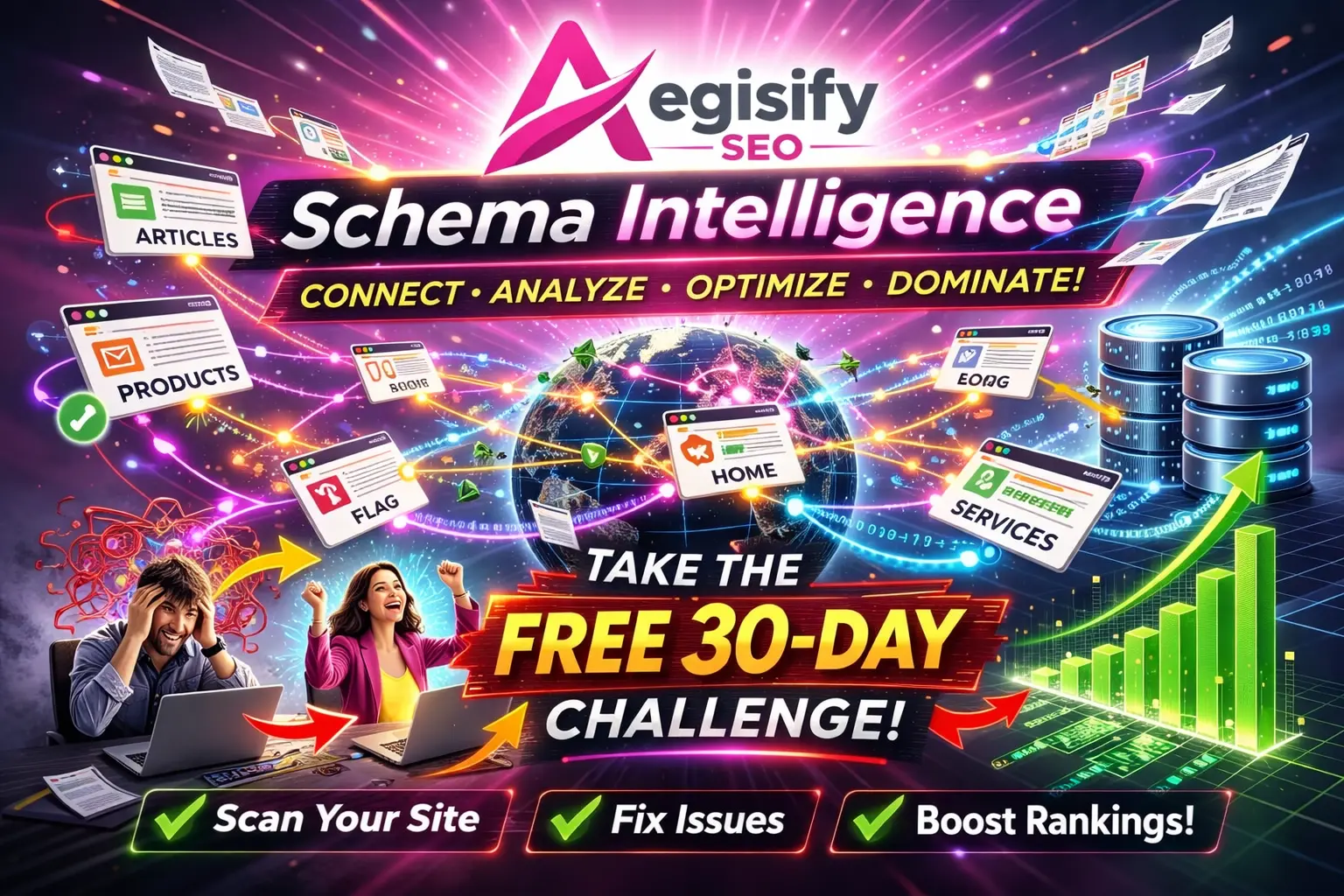
Aegisify SEO’s Schema Intelligence workflow brings those responsibilities into one WordPress operations center. It helps administrators evaluate how structured data is distributed across the site, identify weak or disconnected pages, inspect entity relationships, validate generated output, and prioritize controlled improvements without presenting an internal score as a Google ranking signal.
What Is Schema Intelligence?
Schema Intelligence is a licensed area within the Aegisify SEO Ops Center that evaluates sitewide structured-data conditions instead of looking at one page in isolation. The current product guide documents analysis for entity coverage, graph connectivity, missing properties, broken references, strong entity hubs, weak pages, knowledge-graph readiness indicators, page-level drilldown, graph preview, and validation support.
That makes it useful as a diagnostic and governance layer. It can show where schema is thin, duplicated, incomplete, disconnected, or controlled by competing plugins. It can also help administrators decide which problems deserve remediation first.
Entity Coverage
Review which structured-data types and entities appear across public content, including articles, pages, products, organizations, authors, offers, and approved custom post types.
Graph Connectivity
Identify whether important entities are connected through consistent IDs and relevant relationships instead of appearing as isolated markup fragments.
Missing Properties
Surface absent or incomplete properties that may reduce clarity or rich-result eligibility for the applicable structured-data type.
Broken References
Find references to entity IDs that do not resolve to a corresponding node in the final structured-data graph.
Structured Data Helps Search Engines Understand Content—It Does Not Replace SEO
Google describes structured data as a standardized way to provide explicit information about a page and classify its content. Correct markup can make a page eligible for supported rich-result experiences, but eligibility does not guarantee that a rich result will appear. Structured-data issues can remove rich-result eligibility without necessarily changing ordinary web-search rankings.
The markup must accurately represent the visible page. Prices, availability, authors, ratings, reviews, FAQs, images, return policies, and other properties cannot be invented simply to increase a completeness score. Google recommends providing fewer accurate properties rather than many incomplete or misleading ones.
| Diagnostic Area | What to Review | Safe Operational Response |
|---|---|---|
| Coverage gaps | Important public pages lack an appropriate schema type, publisher identity, or relevant entity relationship. | Confirm the visible page purpose, select the most specific applicable type, and add only truthful properties. |
| Disconnected nodes | Organization, Website, author, article, product, or page nodes use inconsistent identifiers or fail to connect. | Standardize intended @id values and review relationships such as publisher, author, about, mainEntity, or mainEntityOfPage where appropriate. |
| Missing properties | Required or recommended fields are absent for a supported Google rich-result type. | Use reliable WordPress or WooCommerce source data and avoid generating values that are not visible or verifiable. |
| Broken references | A node points to an entity identifier that is not present in the final graph. | Repair or remove the reference, then inspect the complete rendered JSON-LD rather than only a saved setting. |
| Competing ownership | A theme, WooCommerce, another SEO plugin, and Aegisify all publish overlapping primary schema. | Select an intentional owner, disable duplicate output, purge caches, and validate representative pages. |
| Weak pages | Priority pages show low coverage, limited relationships, invalid fields, or inconsistent entity identity. | Prioritize revenue, product, service, and high-impression pages before lower-value archival content. |
Run a Full Schema Review Before Applying Changes
Begin with a baseline scan of representative posts, pages, products, archives, custom post types, and important conversion pages.
The purpose of the baseline is not to chase a perfect number. It is to identify material weaknesses: missing required properties, duplicate graph ownership, unresolved references, inconsistent publisher identity, weak entity hubs, and priority pages that need closer inspection.
Use Health and Readiness Scores as Prioritization Signals
Schema-health and knowledge-graph readiness indicators can summarize complex sitewide conditions into a manageable operational view. They may reflect completeness, coverage, connectivity, and reference integrity, depending on the installed build.
These are Aegisify diagnostics—not scores supplied by Google, Schema.org, or another search engine. A higher internal score may show that known structural issues were corrected, but it does not prove higher rankings, Knowledge Panel eligibility, rich results, traffic, or AI citations.
Apply Non-Destructive Schema Improvements With Guardrails
Aegisify SEO supports controlled schema enrichment and reviewable remediation workflows. Depending on the installed version, license, content type, and configuration, supported improvements may use existing WordPress identity, title, excerpt, author, featured-image, publisher, page, and WooCommerce product data to complete intended output.
Render-time enrichment can avoid unnecessary changes to post content, but it still changes the public structured data seen by crawlers. Administrators should preview applicable actions, confirm the source data is correct, avoid overwriting intentional schema, record the activity, and validate the rendered page after deployment.
Inspect the Final JSON-LD, Not Just the WordPress Settings
A configuration screen cannot reveal every theme, cache, page-builder, commerce, or plugin interaction. Schema Intelligence provides page-level drilldown and graph-preview support so teams can inspect the actual relationships and identify where a problem originates.
Validate representative URLs with Google’s Rich Results Test for Google-supported features and use Schema.org validation for broader vocabulary review. Then inspect the rendered source to confirm one intended graph, accessible image URLs, correct canonical references, current product facts, and no hidden or misleading structured content.
A Safer Schema Intelligence Workflow
Why Structured Data Governance Matters to Serious WordPress Teams
Large WordPress environments often have multiple schema publishers: themes, ecommerce plugins, SEO tools, custom integrations, and page builders. Without ownership controls, the site can produce duplicate Product graphs, inconsistent Organization IDs, stale offers, contradictory authors, or relationships that exist in one template but disappear in another.
Aegisify SEO brings those conditions into a repeatable workflow. SEO teams gain prioritized diagnostics. Developers gain page-level graph evidence. Ecommerce operators gain a source-of-truth model based on current product data. Executives gain a clearer explanation of what was wrong, what changed, and what still requires validation.
Schema Intelligence FAQ
Does structured data directly improve Google rankings?
Structured data can help Google understand page content and can support rich-result eligibility. It is not a guaranteed ranking improvement, and structured-data penalties generally affect rich-result eligibility rather than ordinary web ranking.
Does a high Schema Health Score guarantee a Knowledge Panel?
No. Aegisify readiness indicators are internal diagnostics. Google independently determines entity understanding, Knowledge Panels, indexing, ranking, and search presentation.
Should every WordPress page use the same schema type?
No. Use the most specific applicable type for the visible content and page purpose. A product, article, organization page, location, and ordinary webpage have different structured-data needs.
Can Aegisify safely fix every missing field automatically?
No automated system should invent facts. Supported enrichment should use reliable existing data, remain reviewable, and be validated against the rendered page. Some issues require editorial or developer decisions.
Why does schema ownership matter?
Multiple plugins can publish overlapping or contradictory graphs. Intentional ownership reduces duplication and makes it easier to validate the final public output.
Structured Data and Product References
Editorial references include the Aegisify SEO Product Guide, Aegisify SEO product page, Google’s structured-data introduction, Google’s general structured-data guidelines, Google’s supported structured-data gallery, and Schema.org vocabulary.