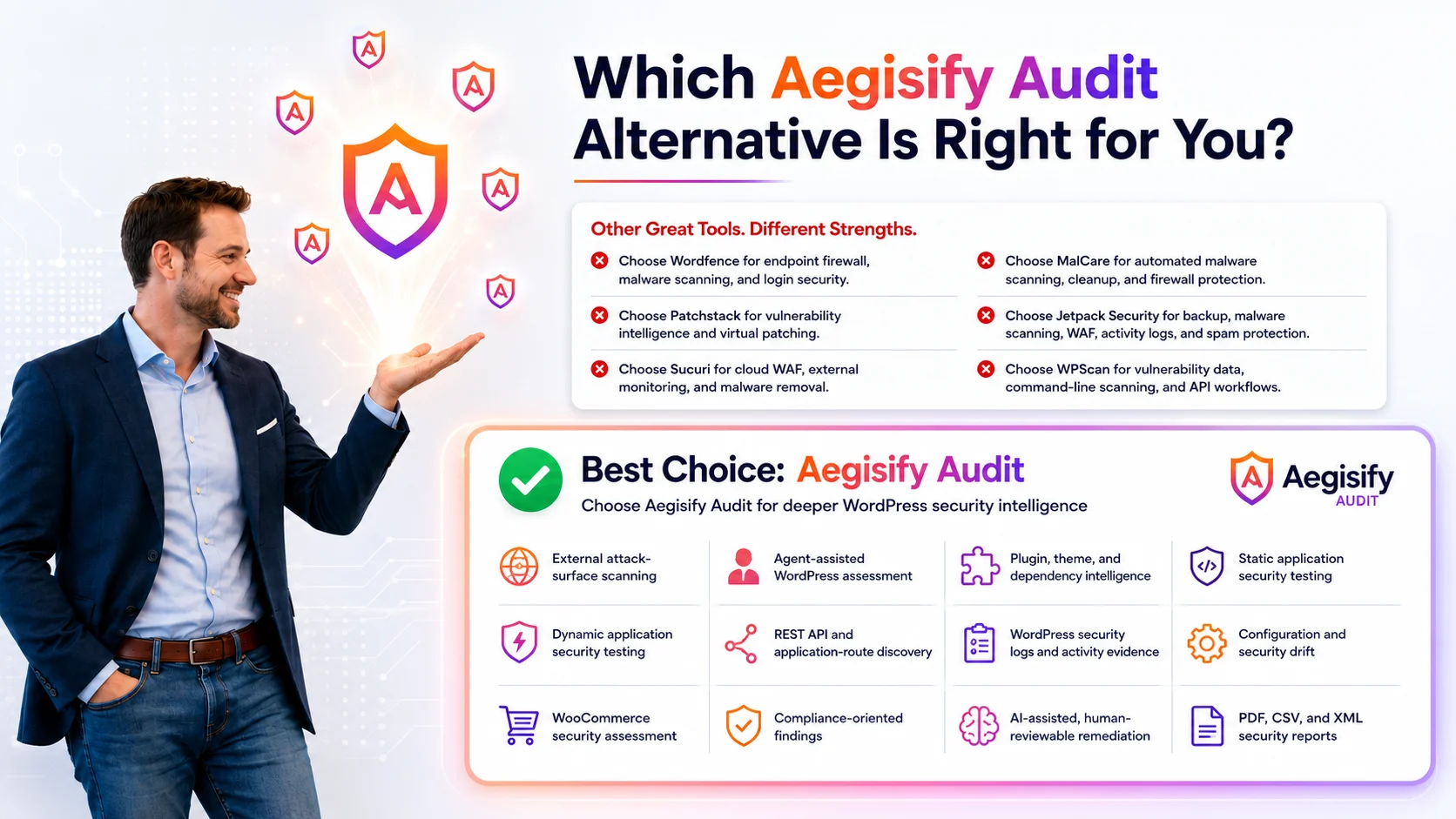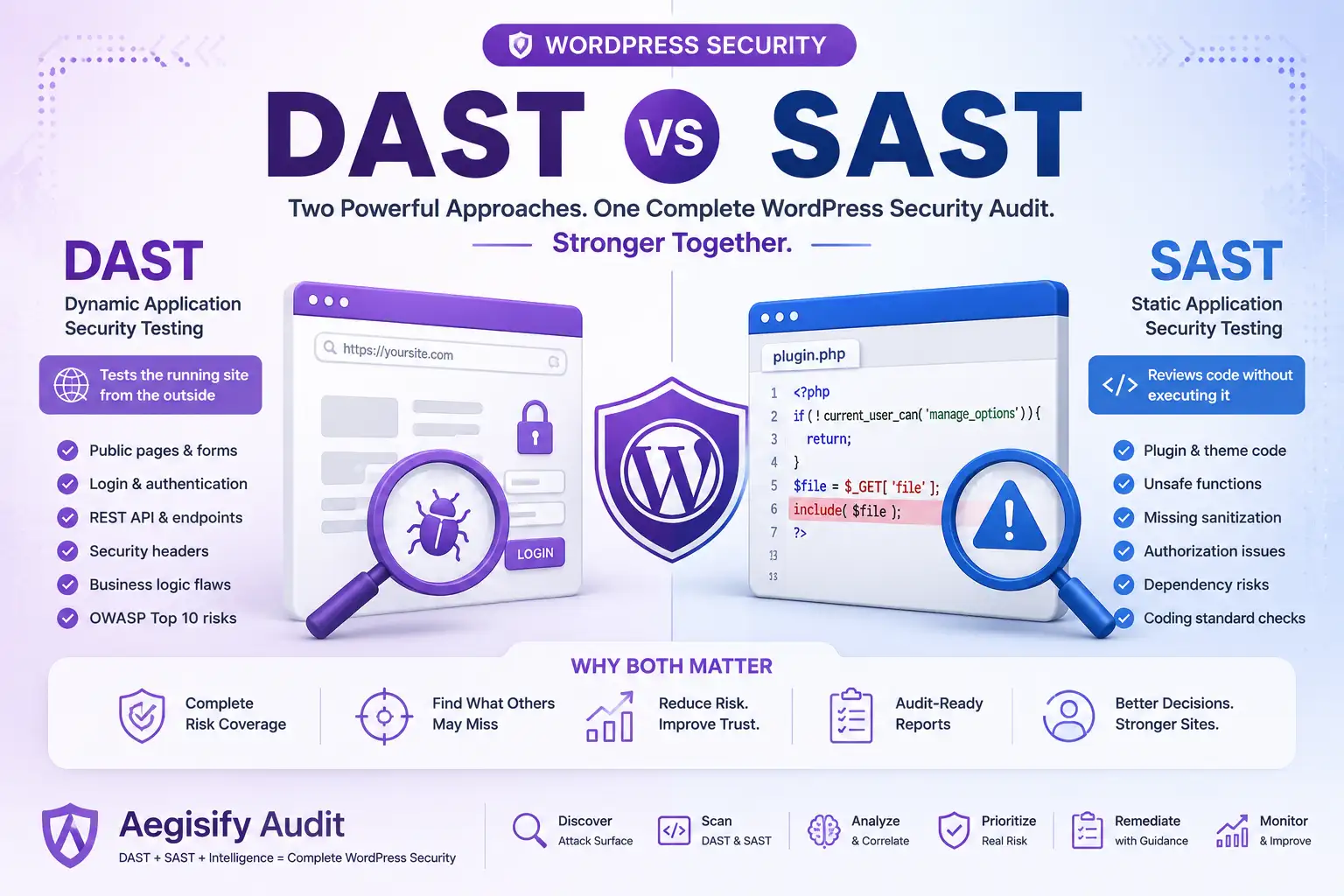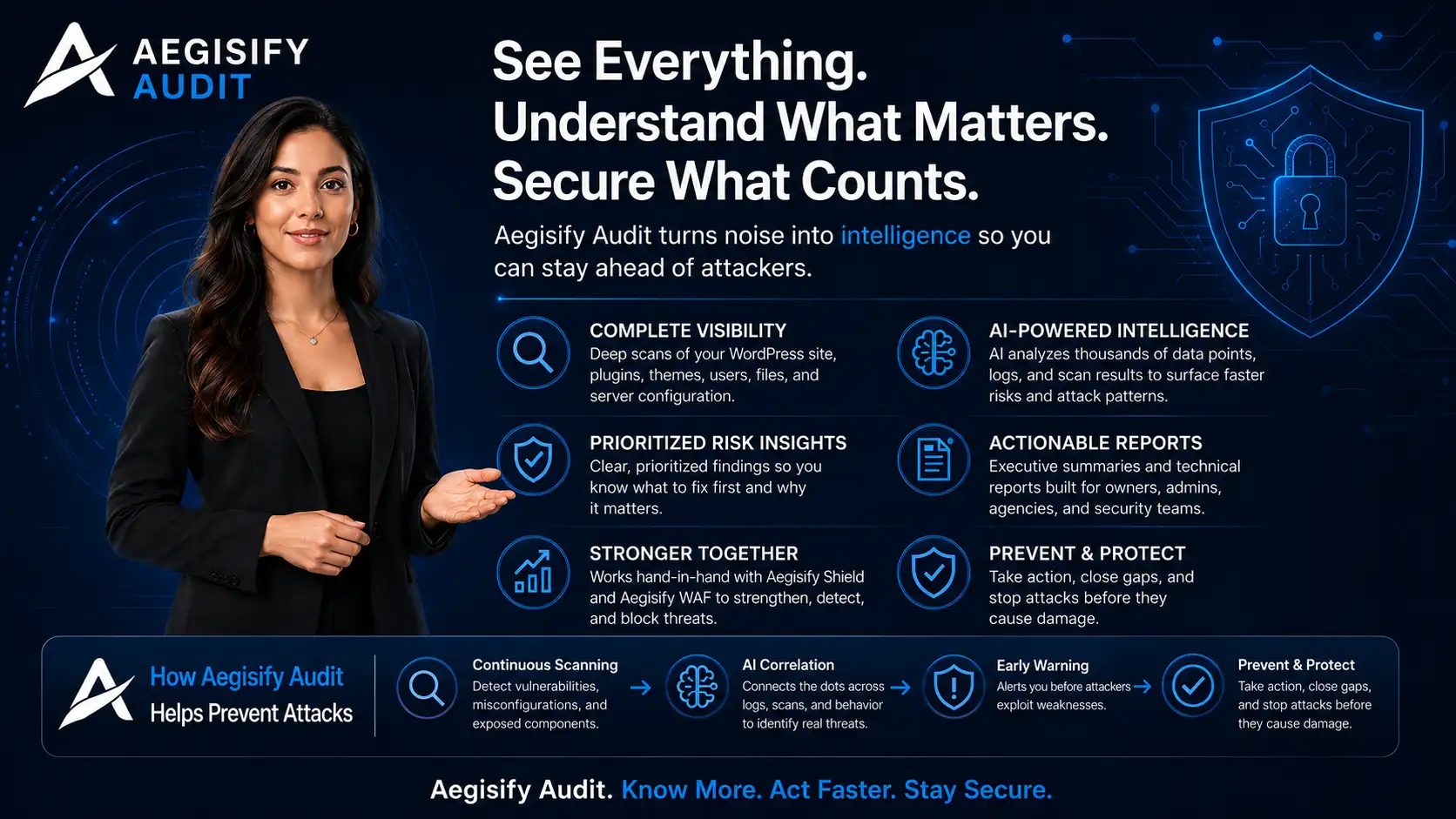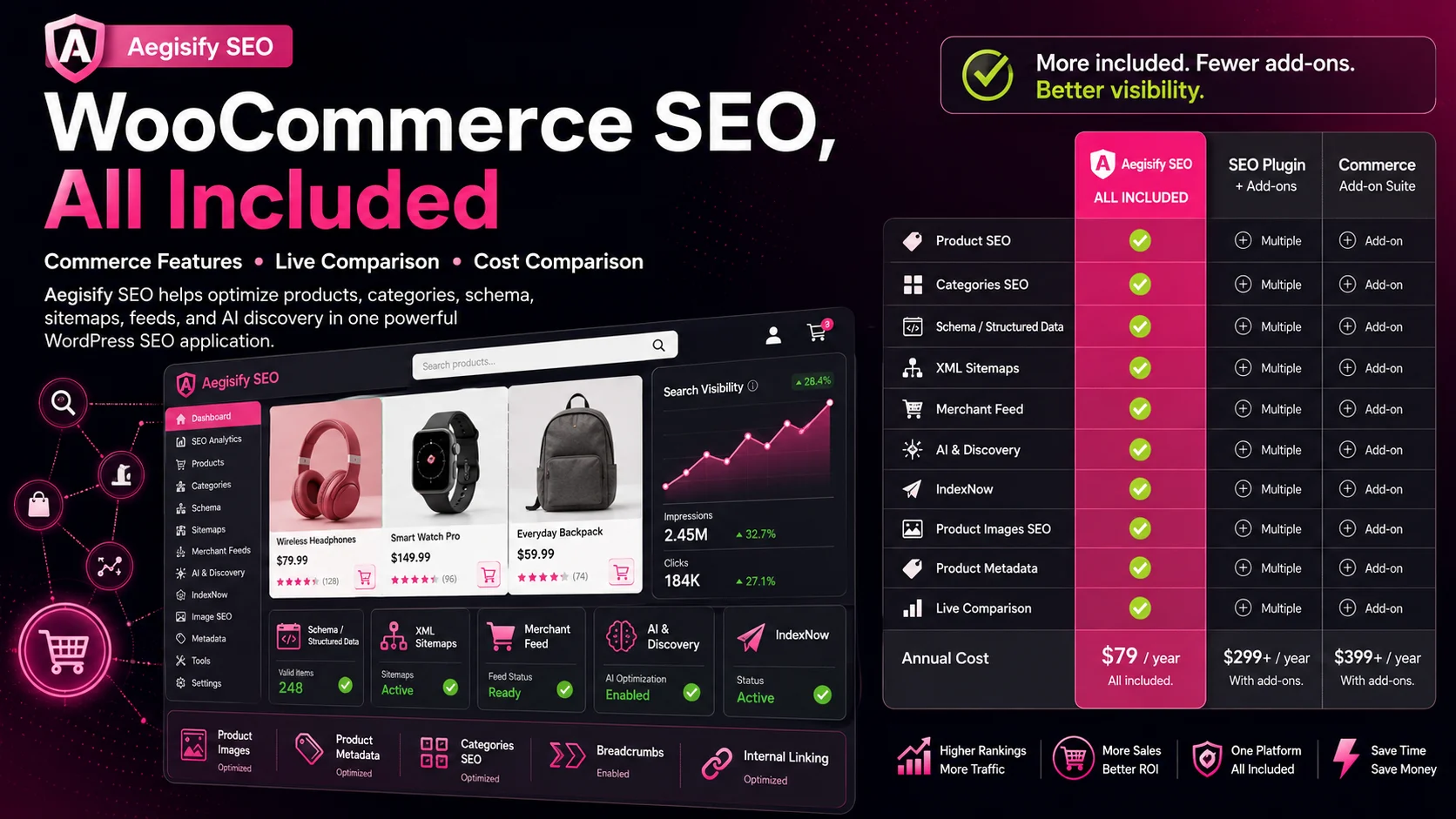
Your WordPress Tools See Pieces. Aegisify Connects the Evidence.
Aegisify brings WordPress protection, SEO intelligence, site activity, and audit analysis into one coordinated operating model. Aegisify WAF and Shields help defend the site. Aegisify SEO helps improve search visibility with AI-assisted analysis and Google Search Console intelligence. Aegisify Audit then correlates supported security, SEO, WordPress, activity, configuration, and operational evidence so teams can understand what matters most—and what to do next.
Security events, configuration changes, SEO signals, search performance, site activity, software risk, and audit findings are more useful when they can be reviewed as connected evidence instead of isolated alerts.
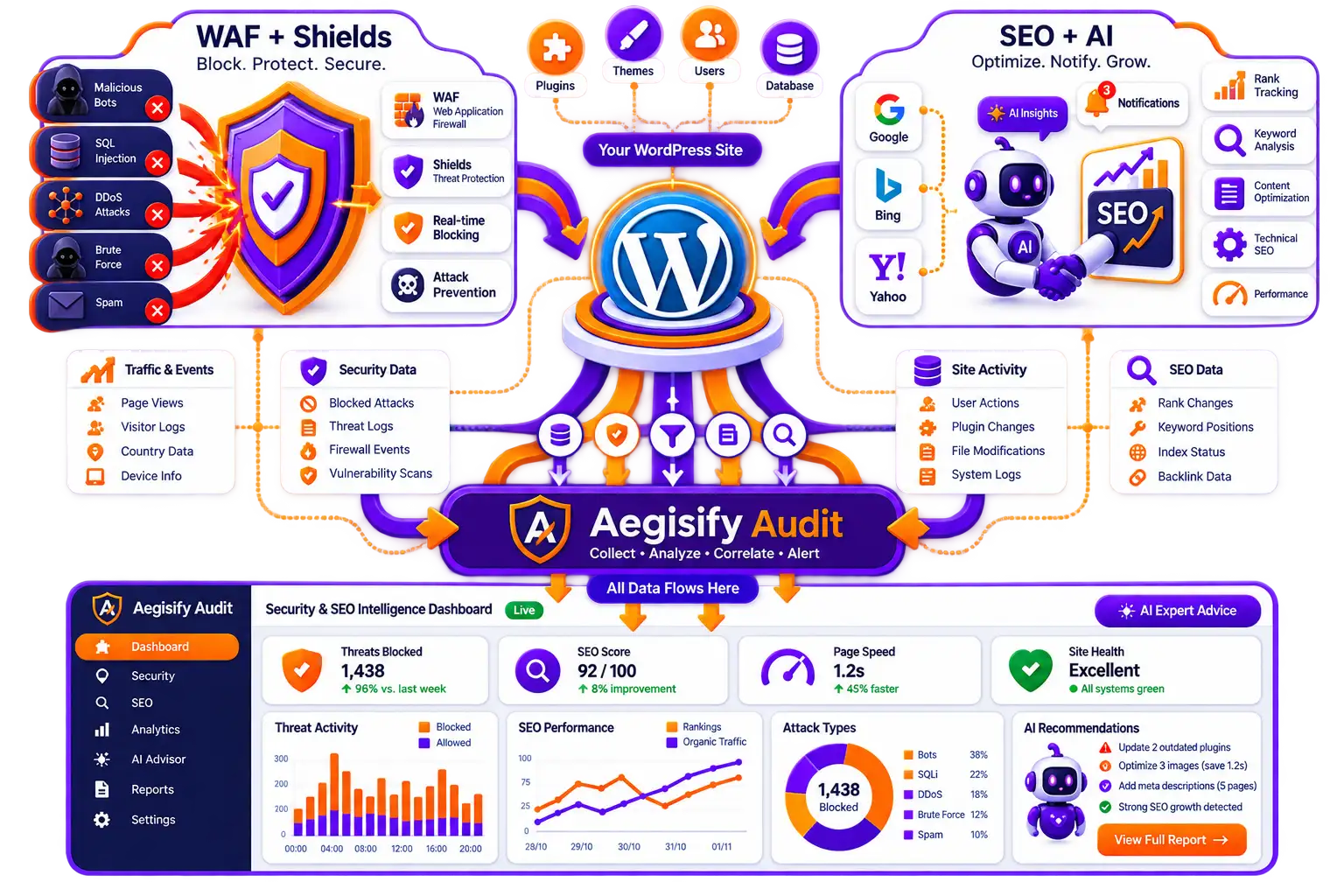
WordPress in the Center. Protection, SEO, Data, and Audit Intelligence Around It.
The architecture is designed around a simple idea: protect the site, improve how it performs in search, collect the evidence that matters, and correlate those signals so the next decision is easier to make.
Protection → WordPress → Intelligence
WAF + Shields: Protect the WordPress Site
Aegisify WAF and Aegisify Shields form the defensive layer around WordPress. The goal is not simply to generate security alerts. It is to reduce attack exposure, enforce defensive controls, monitor important changes, and create security evidence that can be reviewed with the rest of the site.
Your WordPress Site
Core • plugins • themes • users • APIs • configuration • activity • content operations • ecommerce and site workflows
Aegisify SEO: Improve Visibility With Search and AI Intelligence
Aegisify SEO works inside WordPress to help teams identify SEO issues, improve site optimization, use AI-assisted recommendations, and understand search performance. Google Search Console intelligence adds real search visibility signals so optimization decisions can be tied to observed performance instead of guesswork.
WordPress + Operational Data
WordPress itself produces valuable context: software changes, user activity, configuration state, scheduled work, integrity signals, site health, logs, and other operational evidence. On their own, these signals answer narrow questions. Correlated with security and SEO, they can explain why a change matters.
Aegisify Audit
Aegisify Audit is the correlation and risk-intelligence layer. It is designed to ingest the supported evidence made available from WordPress, Aegisify security products, Aegisify SEO, and other authorized site-intelligence sources so teams can move from raw technical signals to a prioritized security and operational view.
Normalize
Correlate
Analyze
Prioritize
Verify
AI-Assisted Analysis and Expert Guidance
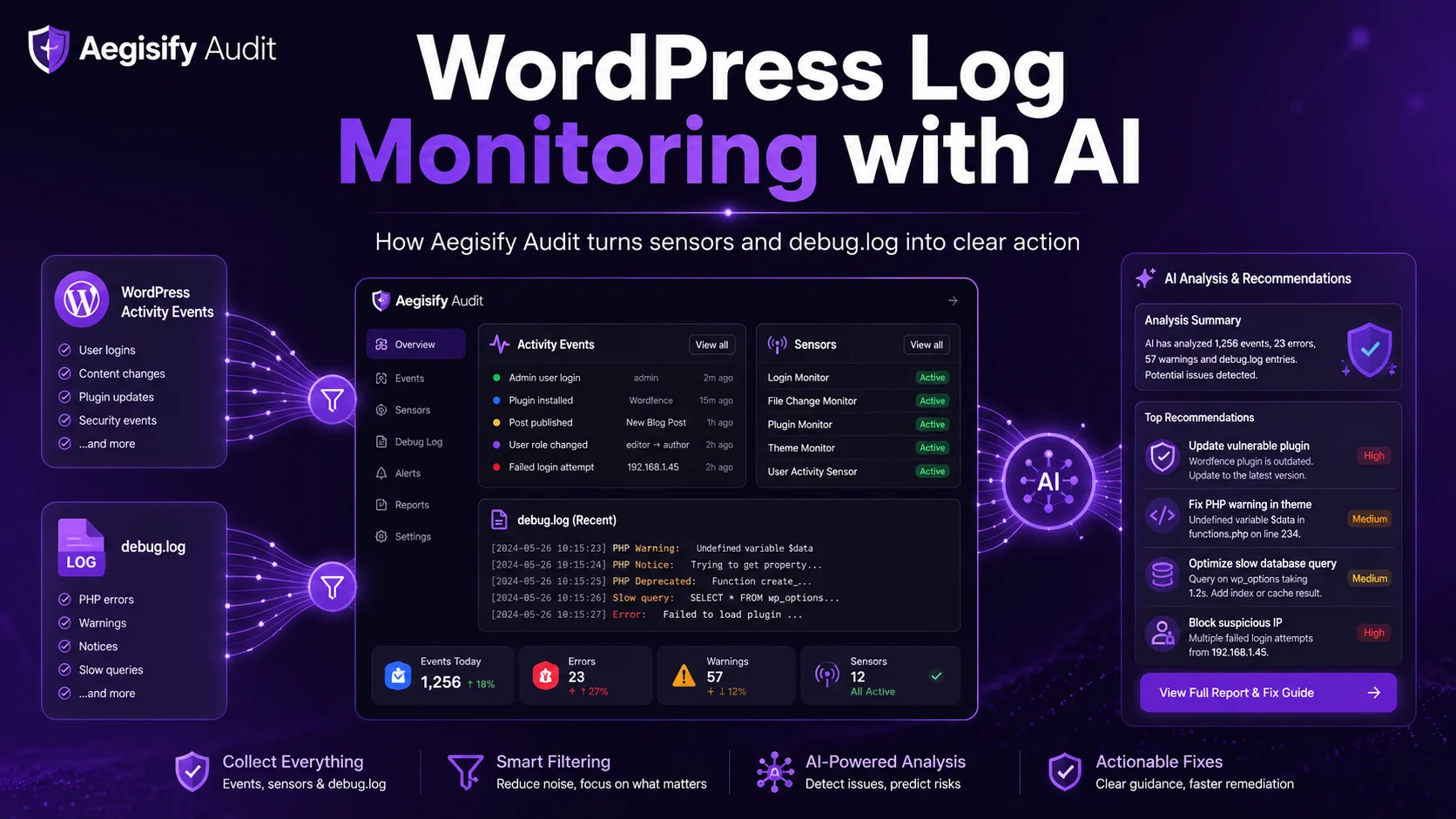
The value is not another dashboard full of disconnected numbers. Aegisify uses AI-assisted analysis to help explain the evidence: which risk deserves attention first, why it matters, what may be contributing to it, what action to consider, and how to verify that the change improved the site.
Most WordPress Teams Already Have Data. They Still Have to Assemble the Story Themselves.
A firewall may know that an attack was blocked. A hardening tool may know that a security setting changed. An SEO tool may know that a page lost visibility. Search Console may show a decline. WordPress may show a plugin change. The hard question is how those facts relate to one another.
That is where isolated-tool workflows break down. A security engineer may be looking at blocked attacks while the marketing team is looking at search traffic and the site administrator is reviewing plugin changes. Each view may be accurate, but none of them automatically explains the broader operational picture.
Aegisify is designed to reduce that fragmentation. Instead of treating WordPress security, SEO, site operations, and audit intelligence as unrelated activities, the platform connects supported evidence into a more useful decision model.
Protect the Site. Improve the Site. Understand the Site.
The strongest Aegisify story is not one feature. It is the way the security, SEO, and audit layers can work together around the same WordPress environment.
Aegisify WAF + Shields
The defensive layer is built around prevention, monitoring, hardening, and visibility. WAF focuses on suspicious and malicious web traffic. Shields focuses on WordPress security posture, configuration, integrity, activity, and related controls. Together they help reduce exposure while producing evidence about what is happening around the site.
Aegisify SEO + Search Console Intelligence
The SEO layer is built around discoverability, technical SEO, optimization, search performance, and AI-assisted analysis. Google Search Console data can add observed query, click, impression, indexing, and search-performance context where connected and available, helping teams make SEO decisions with stronger evidence.
Aegisify Audit + AI-Assisted Risk Intelligence
The audit layer looks across the supported evidence collected from the environment and turns it into a prioritized view. The objective is to explain relationships, surface material risk, identify what deserves attention first, recommend a practical next step, and help teams verify whether the action changed the outcome.
Four Evidence Streams Build a More Complete WordPress Risk Picture
Aegisify Audit is most useful when it can compare different kinds of evidence instead of relying on a single scan type.
Site and Software Context
Supported WordPress inventory, plugin and theme state, configuration, user and administrative activity, scheduled tasks, site health, APIs, integrity signals, and other authorized operational context can help explain what changed and when.
WAF + Shields Evidence
Security findings, blocked activity, defensive-control state, hardening posture, integrity or change signals, attack context, and related evidence can be reviewed as part of the broader site-risk model.
Optimization + Search Intelligence
Supported SEO issues, optimization state, technical SEO conditions, search performance, Google Search Console intelligence, and AI-assisted recommendations can add business and visibility context to the same WordPress environment.
Authorized Operational Signals
Where supported and intentionally connected, Aegisify can use additional evidence such as logs, vulnerability intelligence, code-analysis results, configuration findings, activity history, and other structured site-intelligence sources that help explain risk.
AI Is Most Useful When It Helps Answer the Questions Humans Actually Need Answered.
Aegisify does not need AI to make every decision automatically. The more useful role is to help experts interpret a large body of technical evidence faster and more consistently.
A security team does not need another list of 200 findings. It needs to know which five deserve immediate attention. A site owner does not need a generic “SEO score.” They need to know what changed, what is hurting visibility, and what action is most likely to improve the site. An administrator does not need an unexplained alert. They need context, a recommended path, and a way to confirm the change worked.
What Correlated WordPress Intelligence Can Reveal
The power of correlation is not that every event becomes a crisis. It is that related evidence can be evaluated together.
A Security Event With Context
A WAF event may show repeated malicious requests. Shields may show a related login or configuration concern. WordPress activity may show an administrative change in the same period. Audit intelligence can help place those signals in one review so the team can decide whether the events are unrelated noise or part of a higher-priority condition.
A Search Decline With Operational Context
Search Console may show declining clicks or impressions. Aegisify SEO may identify technical SEO issues. WordPress activity may show a plugin, template, or configuration change near the same time. Correlated analysis helps the team investigate the change with more context than a standalone ranking chart can provide.
Prioritized Risk Instead of Technical Noise
Executives and site owners do not need every raw event. They need a defensible summary: what matters, why it matters, what the likely impact is, who should own the next step, and whether the organization is reducing risk over time.
Evidence That Supports Remediation
Engineers need the technical detail behind the recommendation. Aegisify can preserve the underlying finding, evidence, history, and related context so the recommendation can be reviewed rather than treated as an unexplained AI answer.
Connect Protection, SEO, and Audit Intelligence Around the Same Site.
Start with the Aegisify workflow and see how the security, SEO, and audit layers can work together for a serious WordPress environment.
Aegisify Is Built Around Correlation, Not Another Isolated WordPress Dashboard.
The defensible differentiation is the workflow: security controls, SEO intelligence, WordPress context, and audit analysis are designed to support one another.
Aegisify WAF and Shields are not useful simply because they can produce security information. They become more valuable when that information can contribute to a broader understanding of the WordPress environment. Aegisify SEO is not useful simply because it can surface SEO issues. It becomes more valuable when search-performance evidence can be reviewed alongside site changes and operating conditions.
Aegisify Audit is the layer that brings those signals together. It is designed to help teams move from “What happened?” to “What matters?” and then to “What should we do next?” That is the practical difference between a collection of tools and an operating system for WordPress security and site intelligence.
Common Questions About the Aegisify WordPress Intelligence Model
Is Aegisify a security plugin, an SEO plugin, or an audit platform?
Aegisify is a suite of WordPress-focused products. WAF and Shields address defensive security. Aegisify SEO addresses search optimization and search intelligence. Aegisify Audit is the security-audit and risk-intelligence layer that can correlate supported evidence from the WordPress environment and connected Aegisify products.
Why combine security and SEO evidence?
Security, SEO, and WordPress operations can affect the same site at the same time. A plugin change may affect security posture, performance, indexing, or search visibility. Reviewing related evidence together can provide better context than evaluating each signal in a separate dashboard.
Does AI automatically make security or SEO changes?
AI-assisted recommendations should be treated as decision support. Important security, configuration, code, and SEO changes should be reviewed by an authorized administrator or technical owner, applied through appropriate change control, and verified afterward.
What does Aegisify Audit analyze?
Based on the connected products and authorized evidence available to the environment, Aegisify Audit is designed to analyze supported WordPress, security, vulnerability, configuration, activity, SEO, search-performance, code-analysis, log, and operational evidence. Exact coverage depends on the products, permissions, integrations, and assessment types enabled for the site.
What is the main benefit of correlated WordPress intelligence?
The benefit is prioritization with context. Instead of treating every event as equal, teams can review related evidence, understand likely impact, decide what deserves attention first, receive practical guidance, and verify whether remediation improved the environment.
Does Aegisify guarantee protection or search rankings?
No security or SEO platform should promise guaranteed protection or rankings. Aegisify is designed to improve visibility, defensive controls, analysis, prioritization, and the quality of decision-making. Search performance and security outcomes still depend on the environment, implementation, change control, content, configuration, and external conditions.