AI SEO Meets Google Search Console: A Smarter WordPress SEO Operations Workflow
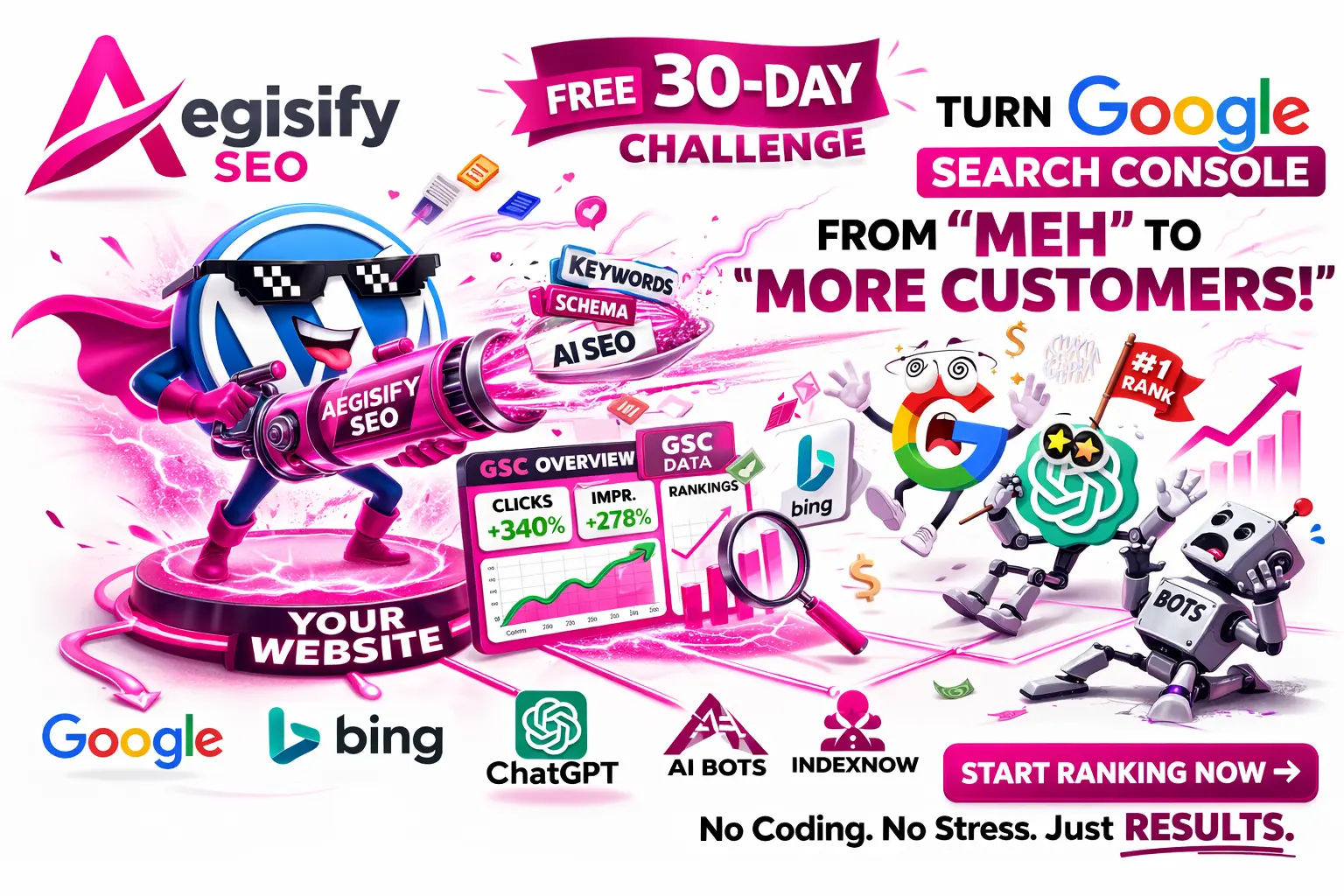
AI SEO for WordPress in 2026 is not about adding more keywords or rewriting every title. It connects Google Search Console integration, GSC Search Stats, Schema Intelligence, technical SEO, Bing and IndexNow, crawler governance, AI discovery resources, controlled remediation, and evidence inside one practical WordPress SEO workflow.
Aegisify SEO is designed around that operating model. It brings search-performance data, sitewide scanning, metadata, schema, canonicals, sitemaps, internal linking, indexing controls, AI-assisted recommendations, public discovery files, evidence, and supported rollback into the WordPress environment where teams already manage content.
What AI SEO Means in 2026
Modern AI SEO combines durable search fundamentals with operational intelligence. Important pages still need to be crawlable, indexable, canonical, internally linked, useful, and snippet-eligible. Structured data must match visible content, and AI-assisted recommendations should remain reviewable.
Google’s current guidance is direct: the same foundational SEO practices that support traditional Search also support Google’s generative AI experiences. There is no special markup that guarantees inclusion, and no WordPress plugin can promise rankings, indexing, rich results, citations, or placement in an AI answer.
Search Performance
Use clicks, impressions, CTR, average position, query changes, page movement, device, country, and date comparisons to understand where attention is growing or declining.
Technical Eligibility
Review HTTP status, robots directives, canonicals, sitemaps, metadata, rendered output, internal links, and indexability before trying to optimize content performance.
Entity and Schema Clarity
Evaluate entity coverage, graph connectivity, missing properties, broken references, schema ownership, and whether structured data matches the visible page.
AI and Crawler Governance
Manage crawler access, public discovery resources, privacy controls, AI-bot observations, and the distinction between search discovery and model-training policy.
Google Search Console Inside WordPress—With the Right Expectations
Aegisify SEO can connect to the Google Search Console API through an authorized Google account and the correct site property. Google requires OAuth 2.0 for private Search Console data. The associated application credentials are registered through the Google API Console, commonly within a Google Cloud project.
Once connected, Aegisify SEO can display clicks, impressions, CTR, and average position. The data should not be called fully real-time: Google supports fresh and hourly states, but recent values may remain incomplete while processing finishes.
| Operational Area | What Aegisify SEO Reviews | Practical Decision |
|---|---|---|
| GSC Overview | Search summaries, winners and losers, query clusters, CTR opportunities, and movement across comparison windows. | Choose which pages deserve investigation instead of optimizing the entire site blindly. |
| GSC Search Stats | Clicks, impressions, CTR, position, query mix, page performance, and available comparison data. | Identify rising demand, decaying visibility, weak snippets, or pages that no longer match search intent. |
| Schema Intelligence | Entity coverage, graph connectivity, missing properties, broken references, weak pages, hubs, and validation support. | Improve structured clarity while keeping schema accurate, visible, and owned by one intended provider. |
| Issues and Fixes | Rendered-page output, index blockers, canonicals, titles, descriptions, headings, image-alt conditions, and supported remediation. | Correct material technical problems before spending time on low-impact formatting. |
| Evidence | Recorded SEO actions, timestamps, before-and-after context, activity history, and supported rollback. | Measure improvement carefully and preserve operational accountability. |
Turn GSC Overview and Search Stats Into Prioritized Work
Metrics become useful when they lead to a controlled decision. Strong impressions with weak CTR may indicate a title or description opportunity. Falling clicks may reflect demand, query mix, competition, indexing, seasonality, or a recent release.
Aegisify SEO’s SEO Ops Center connects Search Console context with issues, actions, schema work, and evidence. The goal is not to automate every response. It is to shorten the distance between “something changed” and “we know what to inspect next.”
Use Schema Intelligence as a Diagnostic, Not a Ranking Score
Structured data helps search engines understand page entities and can support eligibility for appropriate rich-result experiences. Aegisify SEO can evaluate graph connectivity, entity coverage, missing properties, broken references, strong hubs, and weak pages while providing page-level drilldown and validation support.
That intelligence must remain grounded. Prices, availability, ratings, reviews, FAQs, authors, organizations, and other properties must match visible content. A readiness score is an internal diagnostic—not a Google score or visibility guarantee.
Generate Supplemental Discovery Resources Without Overpromising Them
Aegisify SEO can generate /llms.txt, /llm.txt, /ai.txt, /ai-index.json, and /sitemap-ai.xml, plus optional documentation folders. These resources inventory selected public content for systems or workflows that choose to use them.
They are not a shortcut into Google AI features. Google states that it does not use llms.txt or similar special AI files for Search or its generative AI visibility. Aegisify therefore positions these outputs as supplemental resources while preserving the fundamentals that matter broadly: indexable HTML, crawlable links, accurate sitemaps, clear entities, useful content, and controlled crawler access.
Notify Supported Search Engines When Public URLs Materially Change
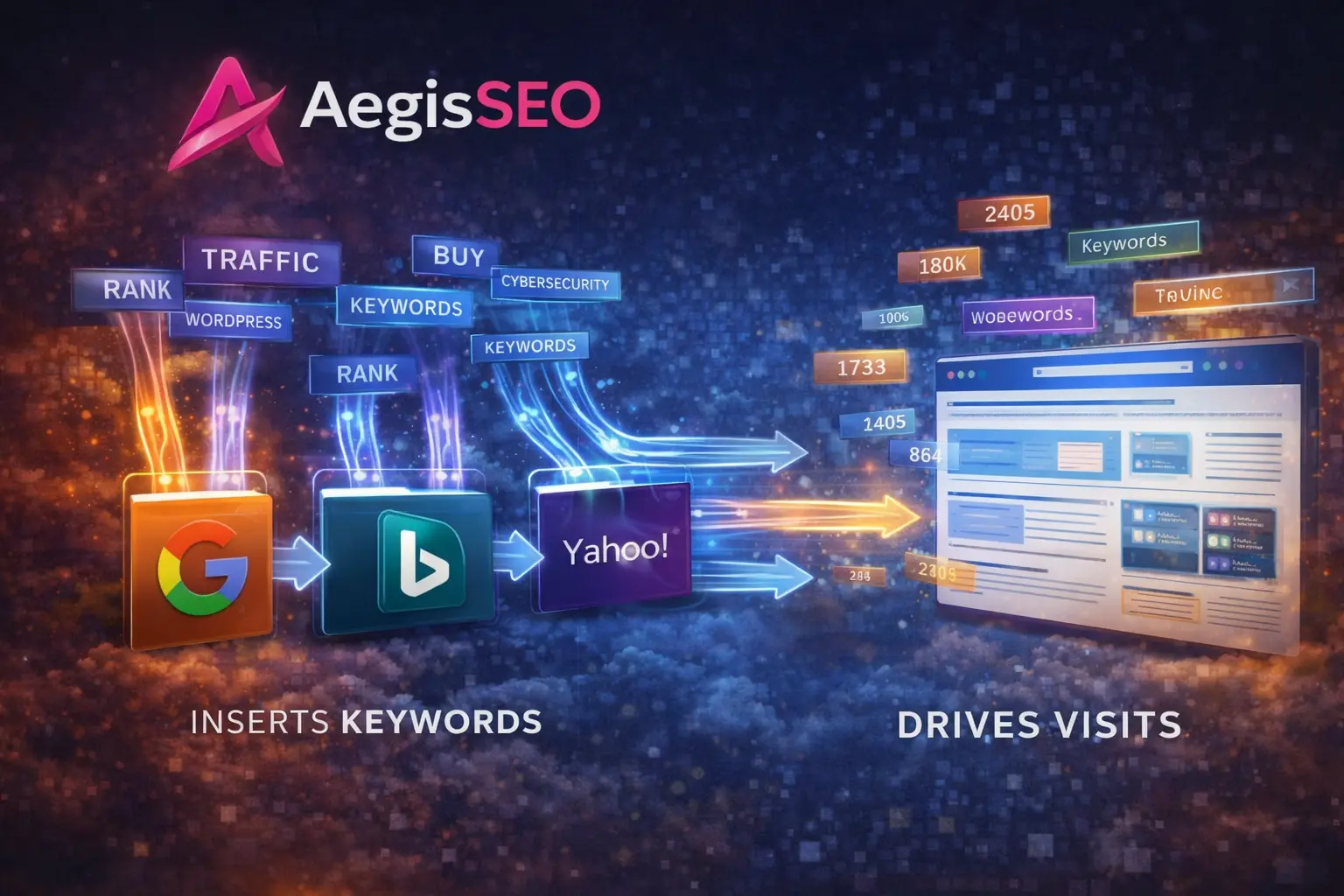
IndexNow allows participating search engines to receive notifications when a URL is added, updated, or deleted. Aegisify SEO can expose a master control, key URL, recent-URL submission, status information, automated supported submissions, and WooCommerce-aware notifications.
IndexNow does not submit ordinary content directly to Google, and a successful notification does not guarantee crawling or indexing. For Google discovery, teams should continue using crawlable internal links, XML sitemaps, Search Console, correct canonical and robots behavior, and helpful indexable pages.
The Aegisify AI SEO Operating Loop
Easy for WordPress Teams. Advanced Where It Matters.
The practical advantage is consolidation. Executives can review search direction, content teams can identify priority pages, administrators can manage integrations and discovery controls, and technical teams can validate HTML, JSON-LD, canonicals, robots directives, and evidence.
Aegisify SEO does not remove the need for judgment. It creates a more disciplined process: fewer disconnected dashboards, clearer priorities, controlled automation, and better proof of what changed.
AI SEO and Google Search Console FAQ
Is Google Search Console data real-time?
Not completely. Google can provide recent and hourly data, but recent values may be partial and can change while processing finishes. Use trends and comparison windows rather than treating one data point as final.
Does IndexNow submit pages to Google?
No. IndexNow notifies participating search engines. Google discovery for normal pages relies on crawling, internal links, XML sitemaps, Search Console, and technically eligible content.
Does llms.txt improve Google AI rankings?
No. Google explicitly says it does not use these special AI files for visibility or ranking. Aegisify generates them as supplemental public inventories for other systems or workflows that may use them.
Can Schema Intelligence guarantee rich results?
No. Accurate structured data can support eligibility and understanding, but search engines decide whether to display rich results. The visible content and final JSON-LD must remain consistent.
Can Aegisify SEO guarantee rankings or AI citations?
No. It can improve technical consistency, discovery, governance, analysis, and measurement. Search engines and AI systems independently decide crawling, indexing, ranking, presentation, and citation.
SEO, Search Console, and AI-Search References
Editorial references include the Aegisify SEO Product Guide, Aegisify SEO product page, Google Search Console API authorization guidance, Google Search Analytics API reference, Google generative AI search guidance, Google structured-data guidance, and Bing IndexNow guidance.