Aegisify WAF AI Security: Protect WordPress Prompts, Data, Agents, Models, and AI Costs
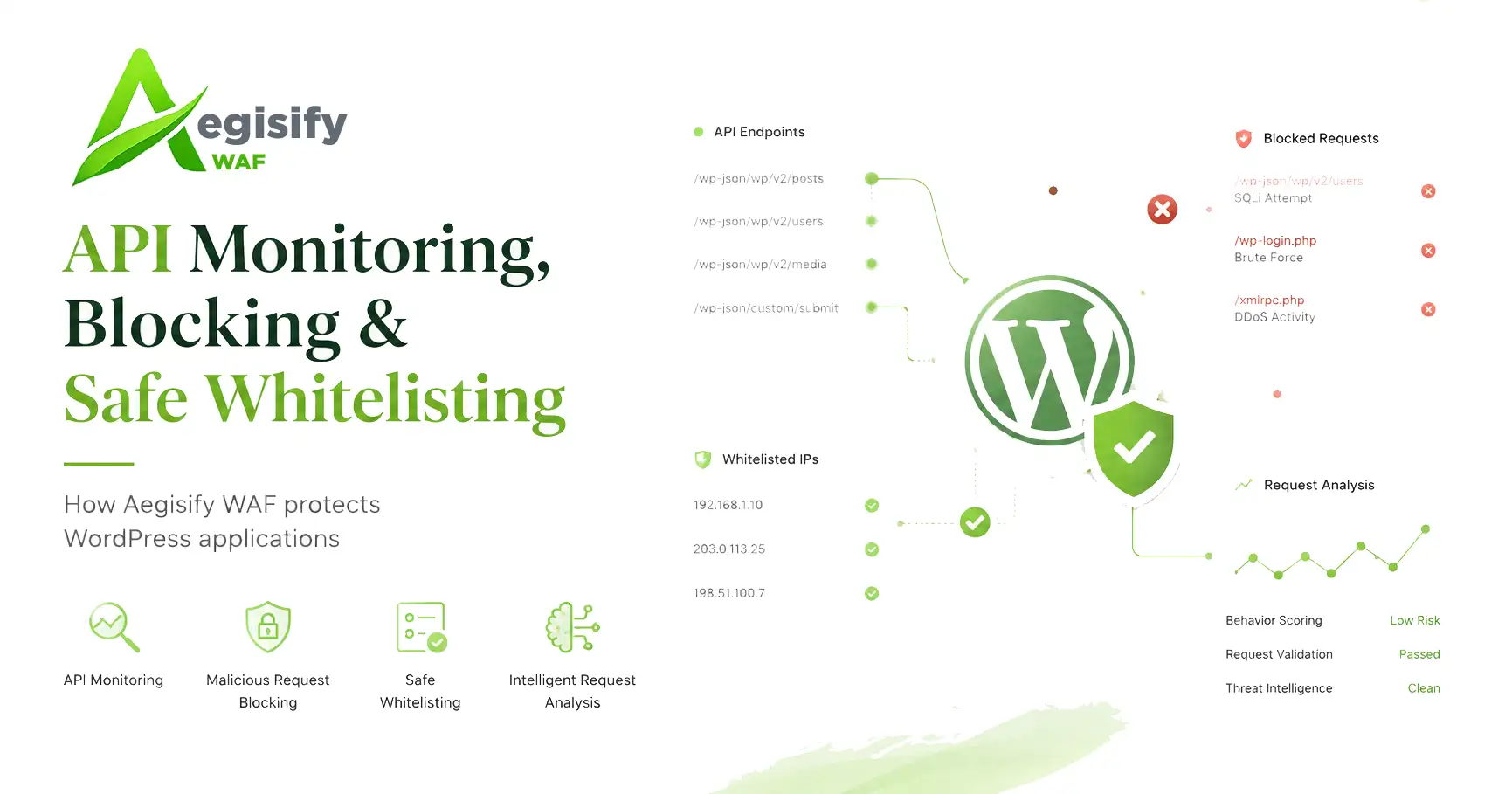
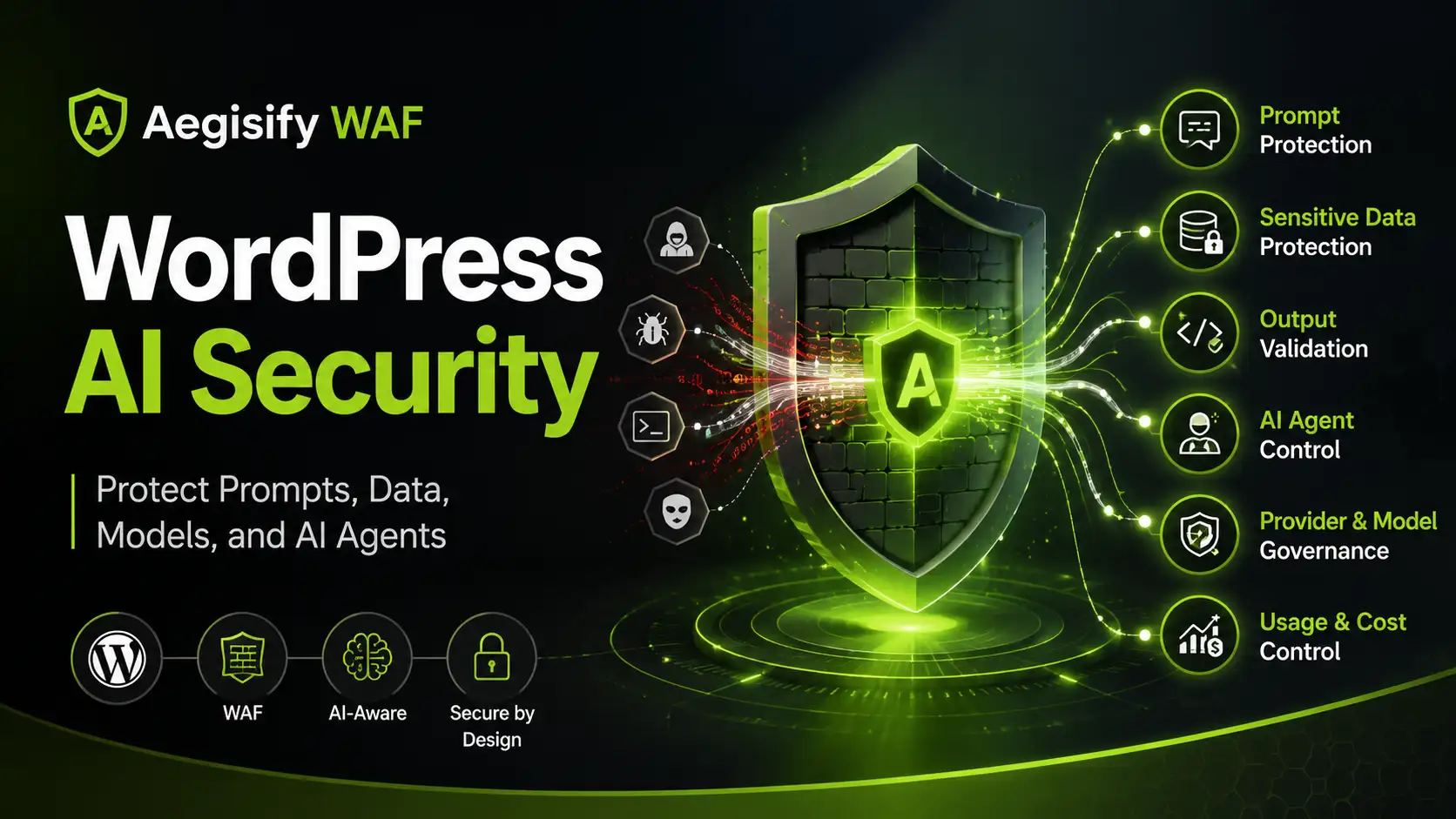
WordPress AI security requires more than a traditional web application firewall. Sites using chatbots, content assistants, AI search, retrieval, automation, model APIs, or agents need controls for prompt injection, sensitive data, unsafe output, excessive agency, provider misuse, and unbounded cost. Aegisify WAF adds a configurable AI application gateway for selected WordPress REST routes, AJAX actions, public paths, and model-provider calls made through the WordPress HTTP API.
The purpose is not to promise that one plugin removes AI risk. It is to place a practical policy layer between traffic, WordPress logic, AI providers, generated output, and consequential actions.
Why AI-Enabled WordPress Sites Need a Dedicated Security Layer
Traditional WAF controls remain essential, but AI introduces different questions. Can a user override model instructions? Is a prompt sending credentials to a provider? Can generated HTML or code be trusted? Is an agent allowed to publish, manage users, or execute a destructive function? Can repeated calls exhaust a budget or slow the site?
OWASP treats prompt injection, sensitive information disclosure, improper output handling, excessive agency, and unbounded consumption as distinct generative AI risks. Aegisify WAF maps WordPress controls to those categories without claiming protection from every model, application, hosting, or supply-chain failure.
Prompt Injection
Score direct and indirect attempts to override instructions, expose system context, manipulate tools, or evade safeguards.
Sensitive Data
Inspect selected inputs, outputs, provider requests, and provider responses for high-risk data patterns.
Output Handling
Treat generated content as untrusted before WordPress, a browser, or another component uses it.
Excessive Agency
Constrain identities, methods, actions, approvals, permissions, signatures, and replay behavior.
Unbounded Consumption
Set request, concurrency, token, and estimated cost budgets for protected application routes.
Providers and Models
Control watched hosts, HTTPS requirements, model identifiers, allowlists, denylists, and response inspection.
How the AI Application Gateway Fits Into WordPress
The gateway applies deterministic local policy around the AI workflow. It does not call a second AI model to decide whether a request is safe.
Prompt Injection Scoring With Tunable Enforcement
Aegisify WAF can score configured prompt fields for instruction overrides, system-prompt extraction, policy evasion, tool manipulation, exfiltration language, and indirect attacks. Administrators can tune thresholds, add indicators, inspect bounded Base64 content, and choose Monitor or Block.
The decision is deterministic and explainable, but it cannot identify every possible prompt attack.
Sensitive Data Detection Before and After the Model Call
Aegisify WAF can check for email, phone, U.S. Social Security number patterns, Luhn-valid cards, selected API keys, bearer tokens, private keys, password assignments, and custom indicators.
Input and provider requests can be monitored or blocked; output and provider responses can be monitored, redacted, or withheld. Pattern detection is a security control, not a legal classification engine.
Validate AI Output Before WordPress Uses It
Generated output should not automatically become trusted HTML, code, or a tool command. Aegisify WAF can limit output size, require structured REST output, detect active content or executable-code indicators, and add defensive headers.
Selected AJAX and front-end responses can be buffered for inspection before unsafe content is withheld or sensitive data is redacted.
Put Authorization Around Consequential AI Actions
When agents can call functions, change content, manage users, or install components, the action boundary matters. Aegisify WAF can require action names, approved HTTP methods, allowlists or denylists, WordPress authentication, a minimum capability, and an approval header.
Service actions can also require HMAC-SHA256 signatures, current timestamps, unique nonces, and replay protection. Endpoint authorization still remains required.
Control Requests, Concurrency, Tokens, and Estimated Cost
Aegisify WAF can apply local budgets per protected route and client fingerprint: requests per minute, concurrency, daily requests, estimated input and output tokens, and estimated cost.
These figures are protective estimates, not provider invoices, but they provide a circuit breaker and evidence for abnormal usage.
Provider, Model, and Transport Policy
For outbound calls through the WordPress HTTP API, Aegisify WAF can recognize providers, watch hosts, require HTTPS, and apply host or model allowlists and denylists. Model identifiers can be resolved from body fields, query parameters, and supported provider paths.
Direct cURL, raw sockets, browser calls, and external services remain outside this hook boundary.
AI Crawler Policy Without Confusing Search, Training, and Security
Aegisify WAF separates user-directed AI agents from model-development and training crawlers. Each purpose can use compatible bot-rate handling, standard controls, or blocking for eligible public requests. A claimed User-Agent never grants protected access or bypasses WordPress permissions, request integrity, or attack signatures.
For AI search visibility, Google says pages still need to be crawlable, indexed, and snippet-eligible. OpenAI separately documents OAI-SearchBot for search discovery and GPTBot for potential training. Site owners can choose different crawler policies without treating robots.txt as security.
Use clear titles, direct answers, descriptive headings, entity consistency, original evidence, crawlable HTML, internal links, and indexable public pages. There is no special markup that guarantees AI citations.
Keep private content behind real authentication and authorization. Crawler compatibility should never weaken application security, WAF signatures, API policies, or WordPress permissions.
What Evidence-Safe Logging Means
The audit trail records bounded metadata such as policy category, decision, route, method, signal IDs, counts, scores, a pseudonymous client fingerprint, and optional provider or model identifiers. It is not intended to store raw prompts, full bodies, output, matched secrets, signatures, nonces, cookies, or credentials.
A Safer Rollout for Existing WordPress AI Features
Broad blocking before understanding the application creates false positives. Aegisify WAF supports a monitor-first rollout so teams can define routes, observe behavior, tune signals, and enforce only validated controls.
WordPress AI Security FAQ
Can a WordPress WAF stop every prompt injection attack?
No. Aegisify WAF adds scoring, route scope, policy actions, and evidence, but secure AI also requires least privilege, authorization, data minimization, provider controls, testing, and human review for material actions.
Does Aegisify WAF use another AI model to decide whether traffic is malicious?
No. The gateway uses deterministic local rules, scoring, identity checks, output validation, provider policy, and usage budgets.
Does the gateway cover every AI request made by a WordPress site?
No. It protects configured REST, AJAX, public application paths, and supported WordPress HTTP API calls. Direct cURL, browser requests, raw sockets, and external services need separate controls.
Will AI crawler compatibility guarantee visibility in Google or ChatGPT?
No. Crawler access can support discovery, but it cannot guarantee crawling, indexing, ranking, citation, or inclusion in an AI answer.
Does AI Security replace the rest of Aegisify WAF?
No. Core WAF inspection, authentication, authorization, API protection, abuse controls, DDoS protection, WordPress permissions, and secure application design still matter.
Security, AI Search, and Product References
Reference material includes the OWASP Top 10 for LLM and Generative AI Applications, NIST Generative AI Profile, Google Search guidance for AI features, Google’s generative AI search optimization guide, OpenAI publisher and crawler guidance, and the Aegisify WAF product page.