Aegisify Sitemap: WordPress Crawl Intelligence for Search, IndexNow, and AI Discovery
Aegisify Sitemap is a WordPress sitemap plugin, robots.txt manager, crawl-efficiency analyzer, IndexNow tool, and AI crawler governance center for sites that need more control than a basic XML generator. It helps administrators organize canonical public URLs, review crawl waste, manage crawler policies, notify participating search engines, and verify discovery endpoints.
Modern visibility extends beyond traditional search results to Google AI features, ChatGPT search, Claude search, vertical engines, and other machine-assisted experiences. The durable strategy is clean technical SEO, clear public content, controlled crawler access, accurate sitemaps, strong internal linking, and measurable discovery signals.
The Sitemap Has Evolved From a File Into an Operating Workflow
Traditional sitemap plugins publish a URL list. A serious WordPress operation must also decide which post types should be public, whether filters are creating low-value combinations, whether sitemap entries are canonical, whether robots.txt blocks important content, and whether every endpoint still works after migrations, cache changes, plugin updates, or WAF rules.
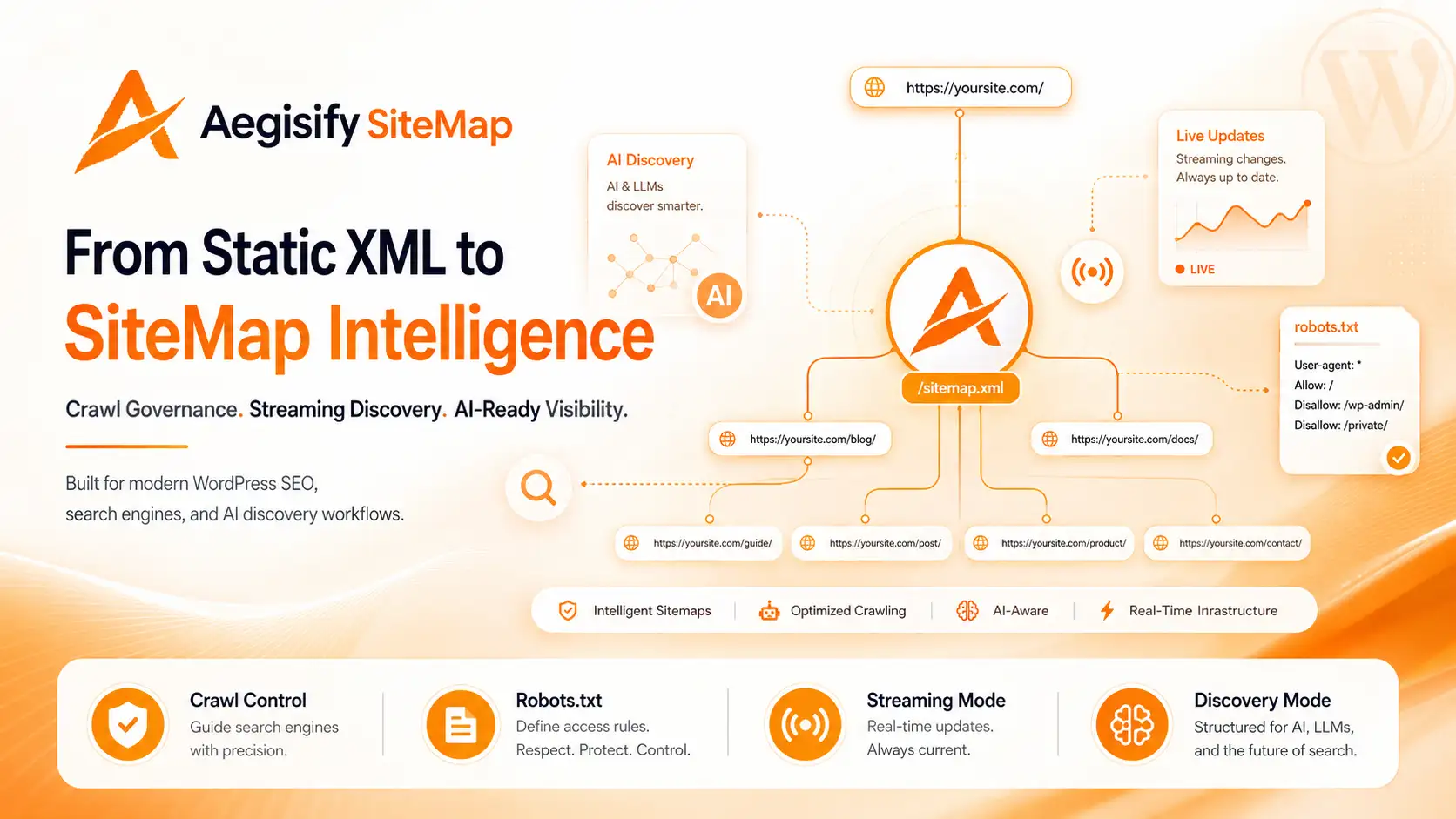
Aegisify Sitemap connects these tasks through XML and child sitemaps, optional image, video, news, and HTML discovery, WooCommerce awareness, exclusions, robots.txt policies, crawl diagnostics, IndexNow, supplemental machine-readable files, health checks, caching, and logs.
From WordPress Content to Controlled Discovery
Identify public post types, taxonomies, products, media, and sitemap endpoints.
Choose what belongs in discovery and review crawler access rules.
Generate canonical XML indexes and supported child sitemaps.
Send eligible URL changes through IndexNow and supported channels.
Inspect endpoint health, logs, webmaster reports, and crawl evidence.
Crawl Efficiency Matters More Often Than “Crawl Budget”
Google’s advanced crawl-budget guidance is mainly for very large or rapidly changing websites, including roughly one million or more pages, more than about 10,000 pages changing daily, or a large backlog of discovered-but-not-indexed URLs. Most smaller WordPress sites do not have a true crawl-budget emergency.
They can still have crawl hygiene problems from internal search, tracking parameters, feeds, faceted WooCommerce filters, duplicate archives, redirects, and low-value URL combinations. Aegisify Sitemap’s Crawl Budget Control Center surfaces possible waste and supports targeted review instead of indiscriminately blocking URLs.
XML Sitemap Intelligence
Publish organized sitemap indexes and child files for content that belongs in search. The objective is to expose preferred, canonical, indexable URLs—not every state WordPress can generate.
Crawl-Waste Diagnostics
Review parameter traps, unnecessary variants, archives, and other signals that may expand the crawl surface. Validate recommendations against analytics, Search Console, store behavior, and business requirements.
Robots.txt Governance
Preview and manage crawler directives, exclusions, and sitemap references from WordPress. Robots.txt is guidance, not security; sensitive content still requires authentication, authorization, or server controls.
Streaming and IndexNow
Notify participating search engines when eligible URLs change. IndexNow does not guarantee crawling or indexing. Support Google through current sitemaps, crawlable links, and Search Console—not the deprecated sitemap ping endpoint.
| Crawler or Objective | What the Control Means | Practical Policy Question |
|---|---|---|
| Google Search | Googlebot access supports Search and Google AI features. Supporting links in AI Overviews or AI Mode must be indexed and snippet-eligible. | Can Google crawl the public pages, resources, and links needed to understand the site? |
| ChatGPT Search | OpenAI documents OAI-SearchBot separately from GPTBot, allowing search and training policies to be managed independently. | Should public content be eligible for ChatGPT search while using a separate training preference? |
| Claude Search | Anthropic documents separate search, user-request, and training-related crawler behaviors. Provider rules can change. | Which Claude-related access supports the organization’s discovery and content policy? |
| Private or Sensitive Content | Robots directives cannot secure a URL and are not guaranteed to be honored by every client. | Are authentication, authorization, server protection, and removal controls protecting the resource? |
AI-Aware Discovery Without AI Visibility Promises
Aegisify Sitemap’s Discovery Mode and AI Discovery Pack create supplemental machine-readable endpoints intended to make important public content easier to inventory. They work best with descriptive headings, clean text, accurate metadata, matching structured data, and strong internal links.
No sitemap, robots profile, llms.txt-style file, or discovery endpoint can guarantee that ChatGPT, Claude, Gemini, Grok, or another system will cite or recommend a page. Google applies normal SEO requirements to its AI search features, while OpenAI and Anthropic publish separate crawler controls. Aegisify helps manage these policies; each platform controls retrieval and presentation.
Move Beyond a Sitemap Toggle
Review what WordPress publishes, govern crawler access, notify supported engines, and verify the result from one operational workflow.
Dashboard Intelligence for Marketing and Technical Teams
Aegisify Sitemap brings sitemap health, robots.txt status, crawl-waste findings, streaming configuration, discovery activation, endpoint checks, and scan activity into one view. Marketing teams can confirm that campaign and product content is exposed through intended paths, while technical teams gain a repeatable deployment and migration checklist.
Control product, category, image, and filter-driven discovery without treating every generated variation as equally valuable.
Maintain current post, image, video, or qualifying news discovery and verify endpoints after frequent updates.
Standardize sitemap, robots, exclusions, IndexNow, and verification practices across client sites.
Preview changes and troubleshoot conflicts involving caches, CDNs, WAFs, servers, or other plugins.
A Safer Five-Step Deployment Process
- Inventory before changing. Open the sitemap index, review child files, identify the current robots.txt response, and document competing SEO or sitemap plugins.
- Include preferred public URLs. Confirm that sitemap entries are canonical, useful, indexable, and appropriate for customers or search visitors.
- Preview crawler rules. Back up the existing robots.txt configuration and verify that critical CSS, JavaScript, APIs, product pages, and content remain accessible where intended.
- Enable notifications deliberately. Validate the IndexNow key and endpoint, then use Search Console and Bing Webmaster Tools as evidence rather than assuming a successful submission equals indexing.
- Verify after every material change. Recheck XML, robots.txt, caches, redirects, firewalls, server responses, webmaster reports, and application behavior after migrations, plugin changes, or policy updates.
WordPress Sitemap and AI Discovery FAQ
Does a WordPress XML sitemap improve rankings?
A sitemap can improve URL discovery, especially for large, new, media-rich, or frequently updated sites. It does not create rankings by itself, and submission does not guarantee crawling or indexing.
Does IndexNow submit URLs to Google?
IndexNow notifies participating engines. Google relies on crawlable links, sitemaps, robots.txt references, and Search Console; its old unauthenticated sitemap ping endpoint is deprecated.
Can robots.txt keep confidential WordPress content private?
No. Robots.txt communicates preferences and may be ignored. Use authentication, authorization, server rules, application controls, and the appropriate removal or noindex method.
Will AI discovery files make Aegisify content appear in ChatGPT or Claude?
No inclusion is guaranteed. Supplemental files may add machine-readable context, but access, indexability, quality, entity clarity, platform policy, and the query affect retrieval and citation.
Does every WordPress site need crawl-budget optimization?
No. Google’s advanced guidance mainly targets very large, rapidly changing, or heavily backlogged sites. Smaller sites still benefit from clean URLs, useful sitemaps, strong links, stable hosting, and fewer crawl traps.
Search, Crawler, and Product References
Editorial references include the Google sitemap overview, Google sitemap submission guidance, Google crawl-budget guidance, Google robots.txt guidance, Google AI features guidance, IndexNow documentation, OpenAI crawler documentation, Anthropic crawler guidance, and the Aegisify SiteMap product guide.