The Future of SEO Is Visibility Inside AI-Generated Answers
AI SEO for WordPress is changing the objective of search optimization. Keywords, rankings, crawlability, indexing, and clicks still matter, but they are no longer the complete strategy. Google AI Overviews, Google AI Mode, ChatGPT search, and other AI-powered experiences can retrieve, compare, summarize, and reference information before a person visits a website.
The challenge is no longer only whether a page can rank. It is whether the content is accessible, clearly understood, relevant, trustworthy, and useful enough to earn a citation or click. WordPress teams must shift from keyword-only publishing to visibility, clarity, evidence, and topic authority.
Traditional Search Was Designed Around a List of Choices
A classic search journey was straightforward. A person entered a query, reviewed ranked results, selected a title, visited a page, and decided whether to take action. Rankings created visibility; visibility created clicks; clicks created traffic; and traffic created opportunities for conversion.
That model remains important. AI search adds another path. A user can ask a detailed question and receive a synthesized response with supporting links. Google says AI Overviews and AI Mode can use query fan-out across related subtopics and sources. ChatGPT search can also return direct answers with source links.
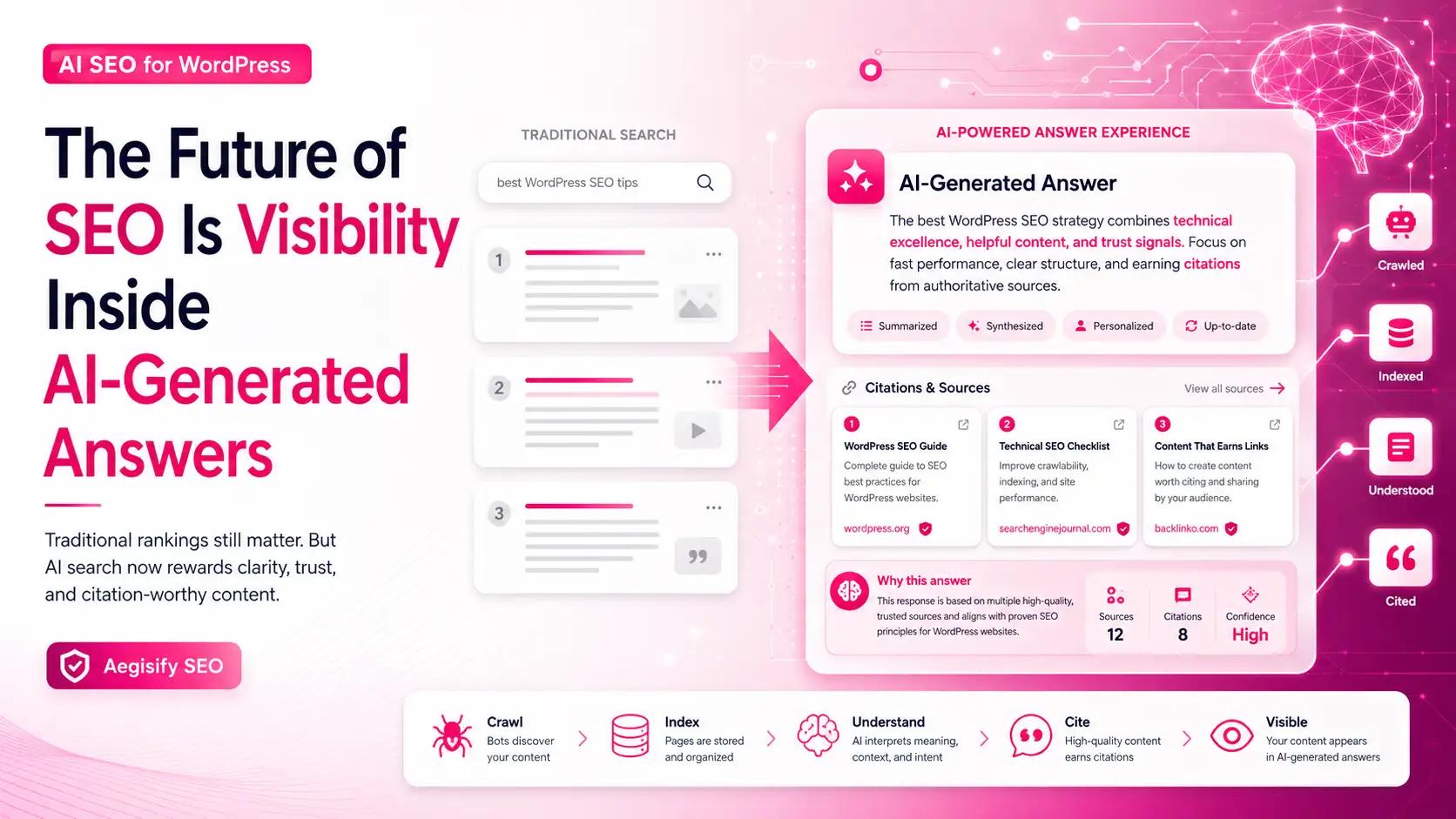
Query → ranked results → website click → page evaluation → conversion opportunity. The page must first win attention in a list of competing results.
Question → retrieval across sources → synthesized answer → cited or supporting links → optional click. The page may contribute value before the visit happens.
Traditional SEO Is Still the Foundation
Google states that a page must be indexed and eligible to appear in Search with a snippet before it can appear as a supporting link in AI Overviews or AI Mode. Google also says existing SEO fundamentals remain relevant and there are no special technical requirements or dedicated AI schema needed for inclusion. AI search optimization begins with sound SEO, not a shortcut around it.
What AI SEO Means for WordPress Websites
AI SEO improves a website for both conventional search results and AI-assisted discovery. It means making content easier to crawl, retrieve, interpret, verify, summarize, and connect to a real user question.
For WordPress, practical signals include clear topics, descriptive headings, direct answers, accurate structured data, crawlable links, clean canonical and index settings, original expertise, consistent brand entities, and current information. These elements serve readers first while reducing ambiguity for search and answer systems.
How AI Search Changes the Content Journey
The system identifies intent, context, and the type of answer needed.
Search systems collect relevant pages, passages, data, images, and sources.
Information is evaluated across subtopics, viewpoints, and supporting evidence.
The system constructs a direct response instead of presenting only links.
Selected sources may appear as citations, supporting links, or next-step resources.
| SEO Area | Traditional Search Value | AI Search Value |
|---|---|---|
| Crawlability and Indexing | Allows search engines to discover, process, and consider pages for results. | Provides the technical eligibility needed for retrieval and supporting-link opportunities. |
| Titles and Headings | Communicate page relevance and help earn attention in search results. | Clarify entities, topics, subtopics, and passages that may support an answer. |
| Internal Links | Help discovery, navigation, context, and authority flow across the site. | Expose related subject coverage and make supporting information easier to retrieve. |
| Original Expertise | Differentiates the page and increases usefulness for the searcher. | Provides examples, evidence, and insight that generic summaries cannot easily replace. |
| Structured Data | Can help search engines understand supported page types and visible content. | Adds machine-readable clarity when it accurately matches the page; it is not a citation guarantee. |
Different Platforms, the Same Need for Accessible and Useful Content
Google AI Overviews provide summaries and links when Google determines the experience adds value. AI Mode supports complex questions, follow-ups, and deeper exploration. Supporting links can differ across Google’s AI features.
OpenAI says public websites can appear in ChatGPT search and advises publishers not to block OAI-SearchBot when they want content considered for summaries, citations, and links. Search access can be managed separately from other crawler purposes. Inclusion is not guaranteed, and robots.txt is crawler guidance—not a security control.
How to Optimize a WordPress Site for AI Search
Use the target keyword naturally, then explain what the subject is, why it matters, how it works, and what the reader should do next.
Place a concise answer near the top so readers and retrieval systems can quickly understand the page’s purpose.
Cover related questions, definitions, comparisons, risks, examples, and next steps without padding the article with generic filler.
Use descriptive headings, tables, lists, and FAQs when they improve comprehension. Keep structured data aligned with visible content.
Review indexing, canonicals, robots directives, sitemaps, page experience, blocked resources, and crawlable internal links.
Align robots.txt, CDN, hosting, and firewall rules with the organization’s visibility policy for Google, Bing, OAI-SearchBot, and approved crawlers.
Add original examples, expert analysis, first-hand experience, frameworks, tools, case studies, and product evidence.
Track qualified traffic, conversions, branded demand, referral sources, indexed coverage, content engagement, and search visibility over time.
How Aegisify Helps WordPress Teams Prepare
Aegisify SEO connects AI-search readiness with practical WordPress SEO operations. Website Scan & SEO reviews pages, posts, FAQ content, and configuration context. Meta & Schema supports metadata and structured information. AI SEO provides human-reviewable recommendations. Sitemaps, Linking Assistant, Issues & Fixes, the SEO Ops Center, Evidence, and dated scans support discovery, prioritization, and change tracking.
Where installed and licensed, Aegisify Sitemap and Link can support URL discovery and internal-link workflows. Teams should also review WAF, CDN, hosting, and robots.txt rules so approved crawlers are not blocked unintentionally. Crawler access should follow a documented visibility and security policy.
The Future of SEO Is Visibility Inside the Answer
Traditional SEO is not dead. It is one layer of a broader discovery system. WordPress sites still need rankings, clicks, and conversions, but they also need content that can be retrieved, understood, compared, and referenced.
The strongest pages will be technically sound, clearly structured, evidence-backed, and rich in genuine expertise. AI is increasing the cost of shallow SEO. Strong content must do more than rank. It must deserve selection.
AI SEO for WordPress FAQ
What is AI SEO?
AI SEO improves content and technical signals for both traditional search engines and AI-assisted discovery experiences such as Google AI Overviews, AI Mode, and ChatGPT search.
Is traditional SEO dead?
No. Crawlability, indexability, page quality, internal linking, titles, and search eligibility remain foundational to AI search visibility.
Can WordPress websites appear in ChatGPT search?
Yes. OpenAI says public websites can appear. Sites seeking inclusion in summaries and citations should not block OAI-SearchBot, but access does not guarantee selection.
Does WordPress need special AI schema?
Google says no special schema or AI-specific markup is required for AI Overviews or AI Mode. Use valid structured data only when it matches visible content.
What should WordPress owners do first?
Fix crawl and index problems, clarify important pages, strengthen internal links, publish original expertise, and review whether crawler controls match visibility goals.
Official Search and Crawler Documentation
Editorial references include Google AI features and your website, Google’s generative AI optimization guide, Google’s people-first content guidance, Google Search Essentials, and OpenAI’s publisher and developer FAQ.
Publication notice: Search and AI experiences change over time. Confirm current crawler names, platform guidance, product capabilities, licensing, and screenshots before publication. Aegisify and other SEO tools cannot guarantee crawling, indexing, rankings, citations, traffic, or conversions.